9 Best Non-Toxic Cookware of 2026 [Chef Reviewed, Rated & Ranked]
Here's the best non-toxic cookware to keep harmful chemicals out of your food for a safe and healthy kitchen. All PFAS and 'forever chemical' free. Tested by an expert chef for 10 years.
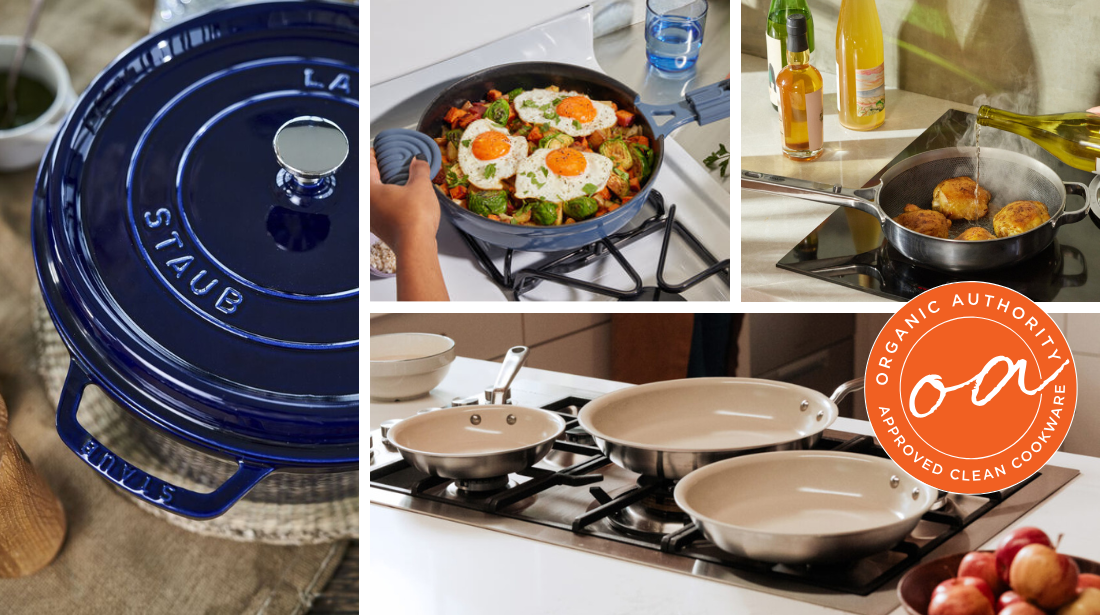
Non-toxic cookware — it’s a hot topic, and for good reason. As we become aware of the danger of PFAS “forever chemicals,” a subclass of toxic man-made substances that include PTFE and GenX, often found in conventional nonstick cookware, it’s no wonder consumers are seeking safe alternatives. But is non-toxic cookware the answer?
In short, yes. But to really get to the bottom of why non-toxic cookware is such a critical investment for any kitchen, we’ll first need to discuss what exactly “toxic” cookware is. We’ll also cover the various PFAS to look out for, including the relatively new replacement chemical, GenX, that DuPont (the maker of Teflon) introduced to replace the now-banned PFOAs — and why this replacement may be even more toxic than its predecessors1.
As a trained chef, recipe developer and founder of Organic Authority, I’ve been professionally testing clean cookware and non-toxic bakeware for over 10 years. All of the pieces that made this list have been fully vetted by me, from the slick ceramic-coated nonstick cookware to the durable stainless steel, carbon steel, and cast iron cookware options. If a product on this list catches your eye, click through to take a look — we might even have an exclusive code to unlock discounts for the Organic Authority community. Let’s dive in.
The Best Non-Toxic Cookware Picks for the Healthy Home Chef
| Award-Winning Nonstick Durability | GreenPan Valencia Pro |
| Best Modern Nonstick Design | Caraway Cookware Set |
| Best Multifunctional Cooking System (+Titanium Cookware) | Our Place Cookware |
| Best Sustainable Legacy Cookware | Alva Cookware |
| Safest Pure Ceramic Cookware | Xtrema Cookware |
| Best Made In USA Ceramic Nonstick | Made In CeramiClad™ Nonstick |
| Best Carbon Steel | Made In Carbon Steel |
| Best Enameled Cast Iron | Staub Enameled Cast Iron |
| Best Stainless Steel | Demeyere Atlantis 7 |
Read on to discover exclusive brand savings from brands like Caraway, GreenPan, Xtrema, Staub, Made In, and more (hint: sign up for the newsletter here to never miss a sale). And don’t forget to bookmark this page to come back and check when your favorite brands offer exclusive sales for the Organic Authority community.
What Is Toxic Cookware?
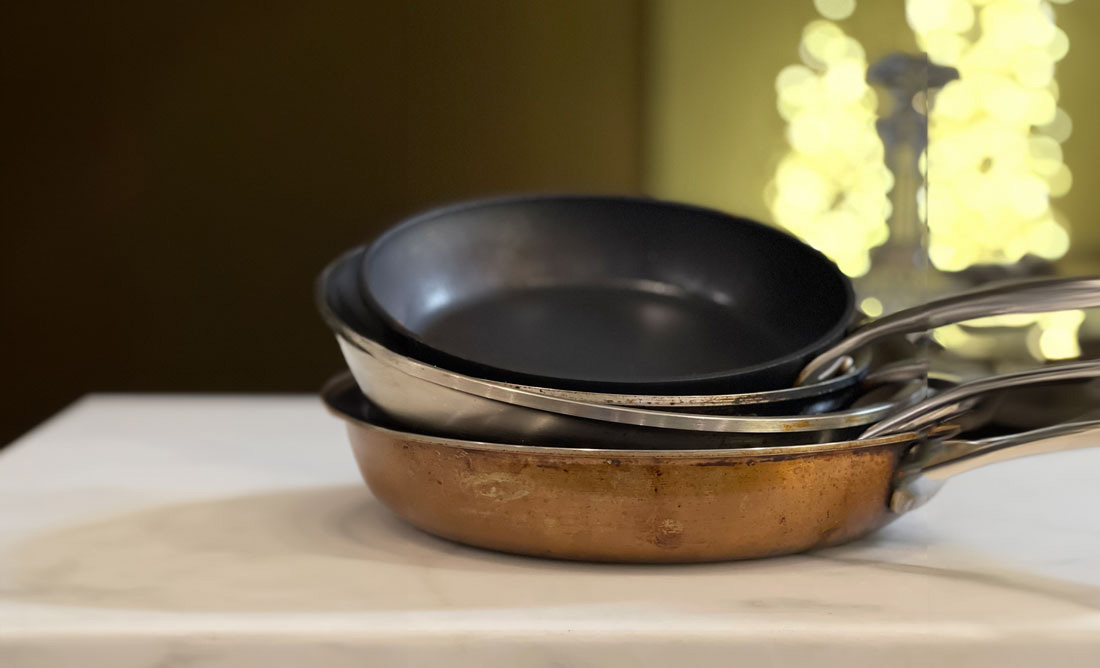
When people refer to ‘toxic cookware,’ they’re usually referring to cookware with a nonstick coating made with a class of over 12,000 man-made chemicals known as per- and polyfluoroalkyl substances, or PFAS. Chemicals like PTFE, GenX, PFOAs, and PFOS all fall under the larger PFAS umbrella2.
PFAS chemicals have earned the nickname “forever chemicals,” because they don’t break down in the environment and can collect in human blood and organs. They’ve been linked to testicular and kidney cancer, infertility, liver damage, thyroid disease, and more3,4. No thanks.
EWG, Ph.D., Senior Scientist, Tasha Stoiber, says this about PFAS:
“PFAS, a family of compounds including Teflon, can be found in the blood of people all over the world, including 99 percent of Americans. The production of consumer goods using these chemicals pollutes drinking water, food and wildlife, and since PFAS do not break down, they remain in the environment and people for decades. Almost everywhere we look we find more PFAS.”
Get this: according to a study in Environmental Science and Technology conducted in 2022, PFAS chemicals are so pervasive that they’re now present in raindrops5. Clouds are now picking up PFAS from our contaminated oceans’ evaporating water.
This is a big deal if you care about your health and the environment. And by cooking with traditional nonstick cookware, you’re not only risking PFAS leaching directly into your meals, you’re also adding more PFAS into the environment. If that isn’t enough reason to switch to non-toxic cookware, we’re not sure what is.
What You Need to Know About Cookware Labels: Forever Chemicals Edition
As with other “clean” or “green” products, claims can be misleading when it comes to cookware. It’s common to see “PTFE-free,” “PFOA-free”, and “made without PFOA” on product labels, but you can’t always trust these claims at face value.
For instance, some brands rename their PTFE coatings with fancy brand names and use a “PFOA-free” label, hoping you won’t know the difference. While technically true, the PFOA-free label is effectively meaningless because the chemical was phased out in 2016 — brands can’t use PFOA anyway, so it’s nothing to boast about.
To avoid forever chemicals, it’s essential to understand what the following labels and terms mean.
PFAS
Per- and polyfluoroalkyl substances (PFAS) is the parent class of synthetic chemicals that includes all of the individual chemicals we’ll dig into below, including PTFE, PFOA, GenX, and more.
This class of chemicals is used in the creation of most conventional nonstick cookware coatings (including Teflon) and are found in many consumer products, from PFAS contamination on staple crops like corn and spinach to breakfast cereals like Cheerios. This widespread use is deeply concerning because of both the risks to human health and environmental contamination6.
PFOA
Also known as C8, perfluorooctanoic acid (PFOA) is a type of PFAS chemical produced and used in products that resist heat, oil, stains, grease, and water, like a stain-resistant carpet. It was also commonly used as a processing aid (a surfactant) to produce another forever chemical called PTFE, so certain products like Teflon pans used to feature both PTFE and PFOA.
After decades of use in the U.S., chemical producers such as DuPont and 3M phased PFOA out in 2016 due to public health concerns kept hidden from the public, including links to an increased risk of cancer and birth defects7. It was a class action lawsuit that ultimately brought internal documents to the attention of the EPA and the general public, leading to its phase-out8.
GenX
GenX, or Hexafluoropropylene oxide dimer acid (HFPO-DA), is a short-chain PFAS that was initially developed as a replacement for PFOA. However, new studies suggest that GenX is just as persistent and potentially as harmful as the banned chemical9. Emerging data from animal studies point to health effects (including cancer) in the kidney, blood, immune system, developing fetus, and liver following oral exposure. The EPA went as far as to release a new toxicity assessment of GenX in 2021, noting that the chemical was more toxic than previously acknowledged1.
PTFE
Originally discovered in 1938 by DuPont, PTFE is best known as Teflon (DuPont’s brand name). PTFE is a more stable and inert chemical than PFOA, and thus PTFE coatings in cookware can often be safe if used as intended. However, overheating a PTFE pan can quickly result in off-gassing that may lead to flu-like symptoms called polymer fume fever3. To give you a sense of the toxicity, these fumes are potent enough to hospitalize humans and kill pet birds9.
The Bottom Line When it Comes to PFAS Chemicals in Your Cookware
PFOA has been banned for years, so consider this label the bare minimum. Instead, look for nonstick coatings made without PFAS, or opt for cookware materials like stainless steel and pure ceramic that don’t rely on a coating at all.
You’ve ditched the forever chemicals. Now match your clean cookware with clean food. Build a free personalized organic meal plan →
“Scientific research has uncovered numerous harmful effects of PFAS on our bodies and well-being, including suppression of the immune system and an increased risk of cancer.”
Tasha Stoiber, Ph.D., EWG senior scientist
So What Is Non-Toxic Cookware?
Generally speaking, “clean” or non-toxic cookware is any cookware that does not contain a nonstick coating made of PFAS chemicals. However, there’s also a concern about some heavy metals like lead and cadmium leaching into food from metal cookware and glazes on enamel-coated cookware. If you are concerned about this (or any other cookware materials), please consult your primary care physician for personalized advice.
So What’s the Safest Cookware for Your Health?
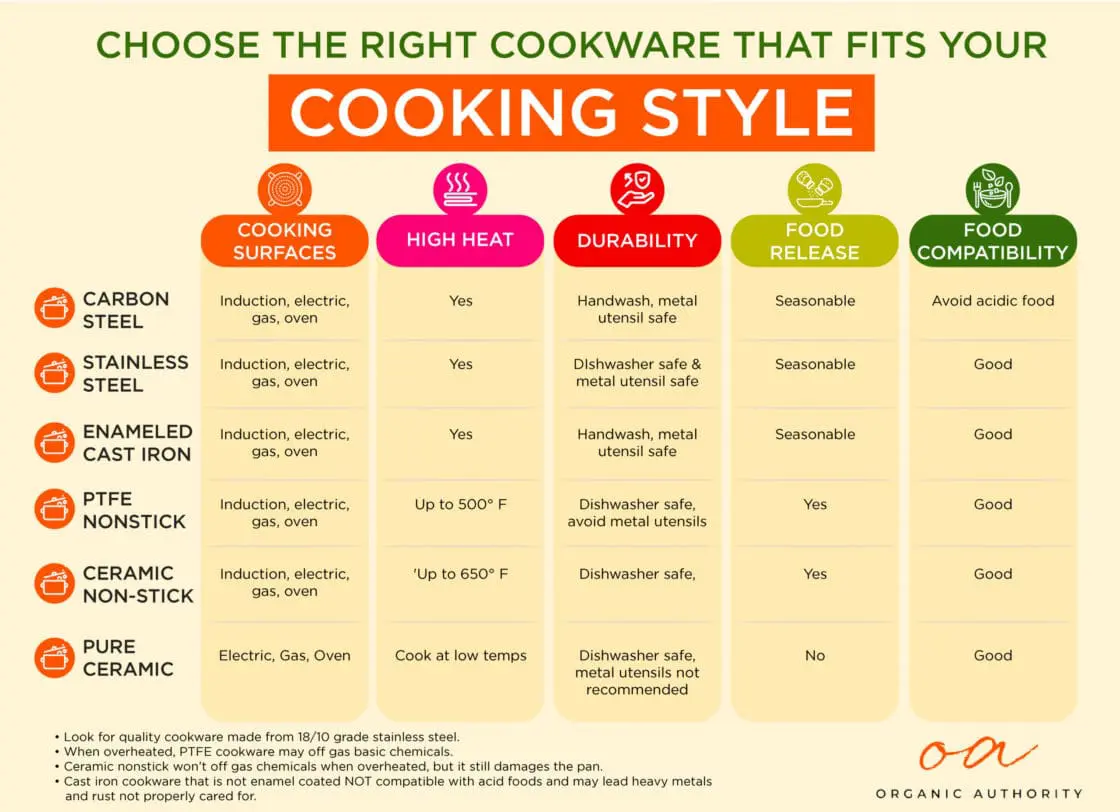
Health is personal, and the safest cookware for you may depend on a few different factors. If you want to avoid coatings, then your choices are pure ceramic, stainless steel (read about the differences between stainless steel and ceramic cookware), cast iron, and carbon steel. If you don’t want to have to sacrifice that easy-release nonstick surface, you can opt for PFAS-free ceramic-coated cookware or enameled cast iron. You’ll notice that all of the cookware picks in this guide are made with one of the materials listed below, so understanding some of the key differences is a good place to start.
| Cookware Material | Benefits |
|---|---|
| Pure Ceramic | Made only with clay, water, natural minerals, and oxides — free of heavy metals and contaminants |
| Ceramic-Coated Nonstick | Naturally nonstick, doesn’t off-gas at high temperatures |
| Stainless Steel | Super durable and capable of handling high heat, delivers the perfect sear |
| Cast Iron | Phenomenal heat retention and long-lasting enough to pass down from generation to generation |
| Carbon Steel | Lighter than cast iron but as durable, excels at high-heat cooking techniques |
But regardless of what material you go for, the products in this guide don’t ask you to sacrifice performance for safety. This guide is the result of over ten years of experience, brought together to provide research-backed cookware recommendations that meet every need, lifestyle, skill level, and frequency of cooking. Each one has earned the “Organic Authority Approved Clean Cookware” seal of approval so you can really trust it’s passed our tests. Now let’s get to my top picks!
Picked your pan? Let us plan the meals. Get an instant organic meal plan tailored to your diet and goals →
The 9 Best Non-Toxic Cookware Brands We Trust
1. Caraway Home: Nonstick Ceramic-Coated Cookware
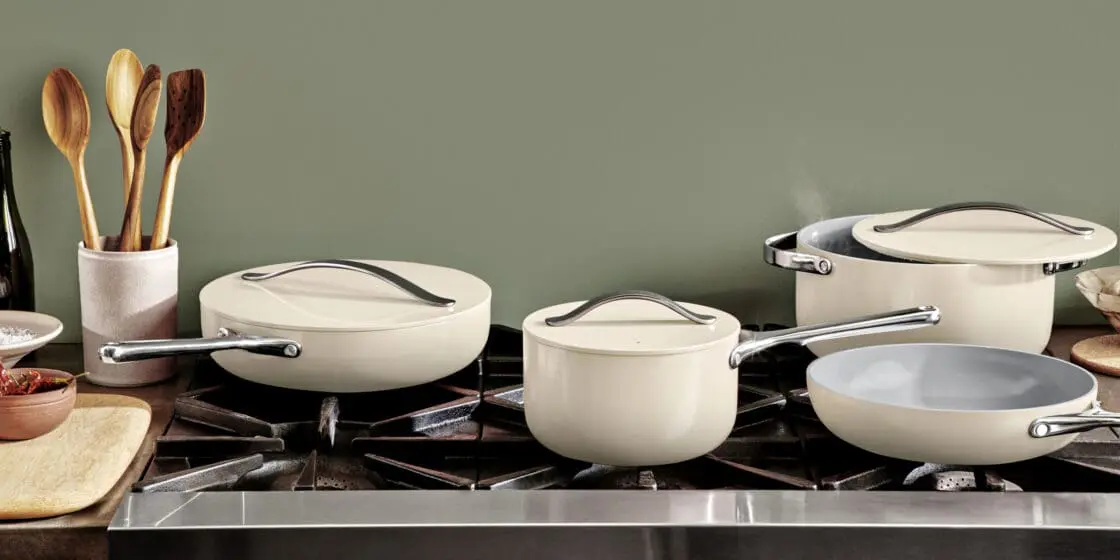
Caraway cookware is any home cook’s dream gift, particularly if you want the ease of nonstick pans. Their sets are always gorgeously designed — I’m a big fan of their Iconics Collection with classy gold-hued handles. Plus, their slick ceramic-coated surface isn’t just convenient, it also has the health benefit of enabling you to use less cooking oil or fat if desired.
You can also read about my team’s top Caraway holiday gift picks here, or explore our recommendations for Caraway kitchen gifts for Mother’s Day here.
Caraway’s Memorial Day sale runs May 11–June 21 and features two of the most complete non-toxic kitchen bundles we’ve seen at this price point. You can stock on cookware, bakeware and summer entertaining essentials and save up to 47% on bundles like the Summer Kitchen Starter Set or Clean Start Bundle.
What Are Caraway Pots and Pans Made Of?
These pots and pans are made with an aluminum core that offers excellent heat retention and conduction, making them one of my favorite options on this list. This is where many nonstick cookware brands fail — especially the cheap ones. We believe in quality cookware that performs and is built to last.
The foundation of the sol-gel ceramic coating is made with silicon dioxide, or silica. A semi-solid, gel-like substance is then applied on top to create a dense and hard nonstick surface — no forever chemicals in sight. This cookware is even California Prop 65-certified, and Caraway’s products are tested extensively by globally accredited third-party laboratories (SGS and TUV) to meet the EU, FDA, and other food safety compliance requirements. In an industry full of false marketing claims and sneaky labels, we love that Caraway offers the utmost transparency.
Testing Caraway Ceramic Cookware
I’ve cooked everything in this set, from fried and scrambled eggs to omelets, pasta, sauces, fish, and veggies. Although the nonstick performs well across the board, I do recommend adding a little oil or butter to the pan when you want perfect nonstick performance for something like eggs.
One of my favorite pieces in the cookware set is the 12’’ (4.5-quart) sauté pan. I love how deep the pan is, making it perfect for large family meals. It also features a great helper handle so you can easily use two hands when transporting a full pan. The lids included in the set come with steam vents, preventing liquids (think soups, steaming hot oatmeal, etc.) from boiling over.
If you want to get the longest life out of these pans, use them on medium to medium-low heat. Avoid high-heat cooking or putting them in the dishwasher (it degrades the nonstick surface quickly).
The Cleanup
I’ve definitely had a few blunders in these pots and pans. I’ve over-reduced pan sauces, burned on cheese (hello nachos!), just generally creating the ideal situation for a stuck-on mess. But even in the face of these messes, the pans cleaned up effortlessly with the help of a little soap, warm water, and a soft brush.
Stovetop Compatibility
Caraway’s pots and pans are stovetop-agnostic, making them safe for induction, gas, and electric stovetops.
Longevity + Durability
The reality is, no nonstick pan lasts a lifetime (even PTFE) — it’s just the nature of these coatings. Heat and repetitive use naturally degrade the nonstick surface over time. But that doesn’t mean you can’t get a lot of use out of them if cared for properly.
I have two sets of Caraway’s cookware and they’ve lasted me years. They’re an investment and I treat them with care. I don’t cook with high heat, I don’t use metal utensils, and I hand wash them. If that sounds like too much maintenance or you really want something that will last forever, you can’t go wrong with Caraway’s stainless steel cookware.
Here’s What You Get When You Buy a Cookware Set
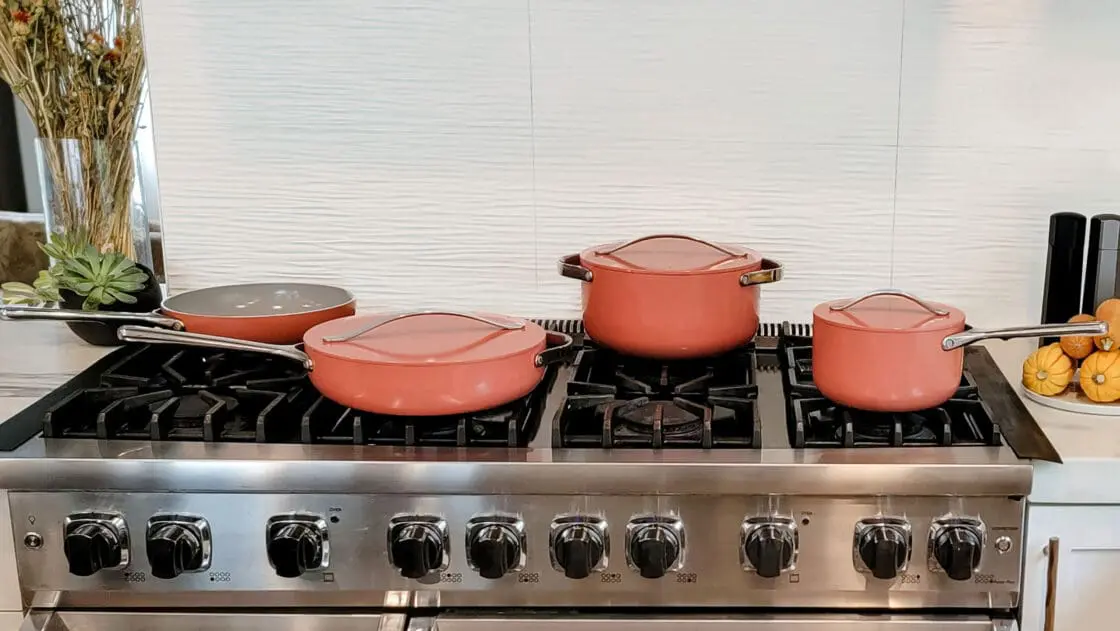
A Caraway set includes four pots and pans plus three lids, including a Dutch oven (most cookware sets don’t include one, which is a shame because we really love Dutch ovens). All sets also come with a magnetic pan rack and a canvas lid holder, which is a great value-add.
The canvas lid holder fits on kitchen cabinet doors to better organize lids that invariably get lost. Caraway is all about these thoughtful and functional inclusions — I experienced the same with their food storage and their bakeware. True form meets function perfection.
Exclusive Savings!
Caraway’s Memorial Day sale runs May 11–June 21 and features two of the most complete non-toxic kitchen bundles we’ve seen at this price point. You can stock on cookware, bakeware and summer entertaining essentials and save up to 47% on bundles like the Summer Kitchen Starter Set or Clean Start Bundle.
Exclusive Savings! Save an extra 10% off with our exclusive code organicauthority2026.
More Options
If you just want to give Caraway a try with a more affordable option, the Minis Duo is an ideal choice for small spaces and apartments. They’re great for warming sauces, melting butter, or frying an egg or two. You can also buy single pots and pans before you take the plunge, too.
On the other hand, if you’re already sold on Caraway, they also sell a Deluxe Set that offers $150 in savings. It combines the 7-piece Cookware Set with storage and a 3-piece Mini Duo to offer everything you need to stock your Caraway dream kitchen.
| Pros | Cons |
|---|---|
| Ceramic-coated nonstick surface | Not dishwasher-safe |
| No PFAS, PFOA, lead or cadmium | Not metal utensil safe |
| California Prop 65-certified, third party-tested | Doesn’t last a lifetime |
| Aluminum core, excellent heat conduction | |
| Oven-safe up to 550°F | |
| Stovetop agnostic | |
| Easy to clean |
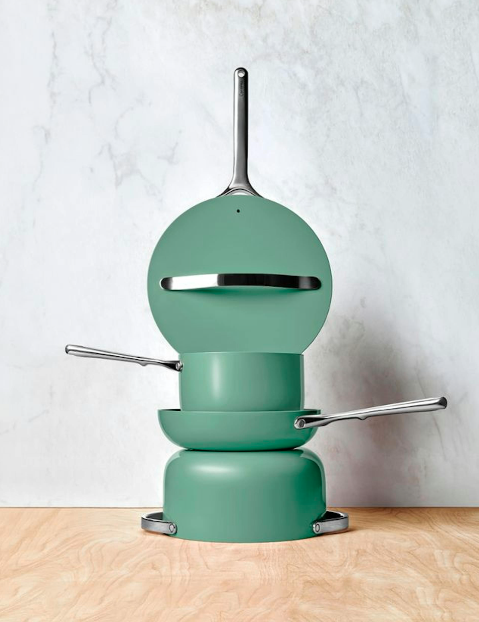
What’s Included in a Set:
- 10.5-inch fry pan
- 4.5-quart saute pan with helper handle, lid
- 3-quart saucepan with lid
- 6.5-quart Dutch oven with lid (big value)
- Plus! A pan and lid storage organizer
Price: $675 $445 at time of publish
Exclusive Savings! Save an extra 10% off with our exclusive code organicauthority2026.
2. GreenPan: Thermolon® Ceramic-Coated Nonstick
What Is GreenPan’s Ceramic Nonstick Cookware Made Of?
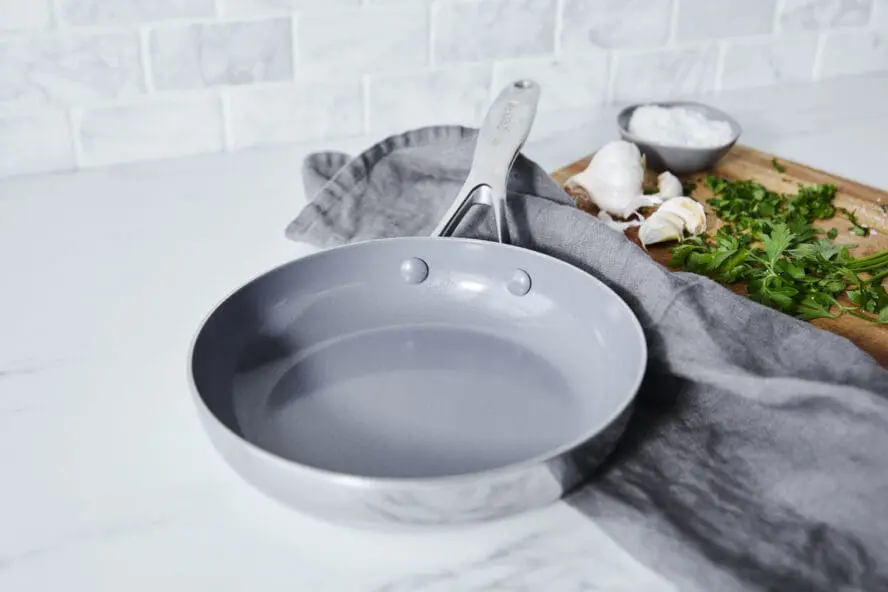
Each piece in the GreenPan collection features its signature Thermolon® ceramic coating derived from sand. As one of the leading safe cookware brands, GreenPan was the first to invent nonstick ceramic cookware in 2007, and they were also the original non-toxic alternative to traditional PTFE nonstick. They’re completely free from plastic, lead, cadmium, and PFAS like PFOA and PTFE — you never need to worry that this cookware will release toxic fumes, even if overheated.
GreenPan also takes green production to the next level. Their curing phase emits 60% less CO2 than traditional coatings, they utilize recycled aluminum, and they have a recycling program for your old cookware. This is true for all of their pots and pans, from their groundbreaking new Spectra line to their super advanced nonstick Reserve Pro line. And they knock it out of the park with their more specialized appliances too, like their GreenPan Frost frozen treat-maker and their trusty non-toxic slow cooker. And not to keep going on, but their nonstick Reserve Bakeware is just as good.
It’s not just me who can vouch for them, either — they’ve been tested by several third-party agencies. They’re the world’s first NSF®-certified ceramic nonstick, meaning their cookware has been tested and certified against rigorous food safety and toxicity standards. They’re also the first cookware company to gain Aluminum Stewardship Initiative (ASI) Performance Standard for the responsible production, sourcing, and stewardship of aluminum.
But beyond non-toxic materials and certified green production, what GreenPan really excels at today is durability — especially with their higher end lines.
GreenPan’s Valencia Pro: Long-Lasting Performance
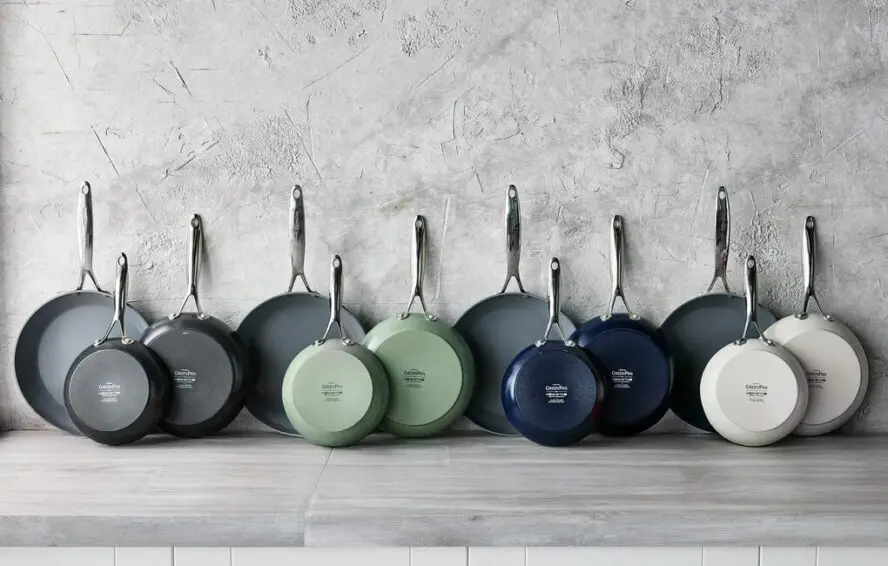
GreenPan’s Valencia Pro collection has been around for roughly 10 years. I’ve been testing it since its initial release, and I feel like the collection just keeps getting better. GreenPan continues to innovate, introducing new colorways, a version with a stainless steel body, and an incredibly comfortable handle (no really — it’s one of the best handles of any cookware line I’ve tested, and I’ve tested endless brands and collections for our guides). For a deeper dive into the Valencia Pro line, including detailed testing of individual pieces, check out my full GreenPan Valencia Pro review.
There’s a lot that sets the Valencia Pro line apart from others. The collection has won awards and praise from America’s Test Kitchen, Good Housekeeping, and Food Network for its durability and performance. In the ceramic nonstick world, durability awards are a big deal — it’s not every day you find nonstick cookware that’s made to last. The Valencia Pro pieces feature hard-anodized aluminum bodies that are pre-treated, making them scratch-resistant and seriously strong. Combined with GreenPan’s diamond-infused Thermolon® ceramic nonstick coating, these pots and pans are unbelievably durable and resistant to daily wear and tear.
The Valencia Pro’s Magneto™ induction base delivers even heat distribution across all cooking surfaces — whether you’re using induction, gas, electric, halogen, or ceramic. They’ve also designed a Balance Pro stay-flat base that’s designed to flex when heated, which means your cooking oil stays where you put it (and you can use less).
Plus, they’re oven-safe up to 600°F (lids up to 425°F) — that’s significantly higher than most ceramic nonstick cookware on the market, making it easy and safe to finish dishes in the oven.
Valencia Pro, Tested
I’ve cooked everything from my morning eggs and delicate fish to braised chicken thighs and large batches of sautéed vegetables in these pans. After my real life tests, I can officially report that this cookware really delivers.
The wider, flatter cooking surface allows you to cook food in an even layer without stacking, which is ideal for achieving that lovely caramelization I’m always after. The curved sides make it easy to flip food — even eggs slide up and out with ease. I also love that these pans are substantial enough to eliminate hot spots (unlike your average cheap, flimsy nonstick) without feeling too heavy to maneuver.
Another one of my favorite features in my tests was the stainless steel handle design. The soft curved lines fit comfortably in your hand, making it easy to pick up and move the pots and pans around the kitchen. The V-shaped cutout in the handle limits heat transfer from the pan to the handle, which is a thoughtful touch (though I still always use hot pads — better safe than sorry!).
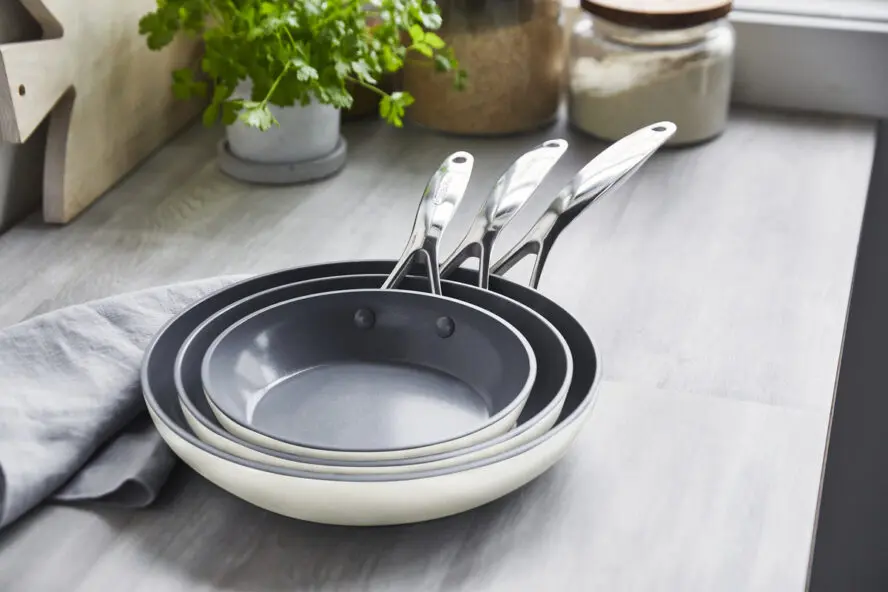
Finally, the ceramic coating held up remarkably well, even with daily use by multiple family members (some of whom are less gentle than others). The diamond reinforcement meant the coating even stood up to my mom’s metal utensil use, although I still recommend using wood or silicone utensils to maximize your cookware’s lifespan.
The Cleanup
Even with the messes I made during my tests, like a sticky situation with maple syrup, cleanup was really easy. The ceramic surface releases food easily with just soap, water, and a soft brush or sponge.
While the Valencia Pro is dishwasher-safe, I opt to hand wash mine to preserve the coating for as long as possible. It’s what I do with all my ceramic cookware, and it’s made a real difference in longevity.
Longevity + Durability
The Valencia Pro stands among the most durable ceramic nonstick options on the market. The hard-anodized construction, diamond-infused coating, and quality of the Thermolon® ceramic mean it stands up to everyday use way better than budget ceramic alternatives.
I’ve seen ceramic pans from other brands wear out in as little as three months, but my Valencia Pro pieces are going strong after years of use. As a testament to this, GreenPan sells the collection with a limited lifetime warranty (although you should still read the fine print, as no nonstick cookware lasts a lifetime). However, if your top priority truly is maximum longevity and you’re willing to give up some nonstick convenience for it, read our review of the GreenPan Reserve Stainless Steel collection to see if that might be a better fit for you.
| Pros | Cons |
|---|---|
| Industry leader for innovation in non-toxic, ceramic nonstick | Dishwasher-safe, but hand-washing extends lifespan |
| Diamond-infused ceramic coating for extra durability | Won’t last a lifetime (no ceramic nonstick does) |
| Hard-anodized bodies for extra strength | |
| Metal utensil safe (though wood/silicone is recommended) | |
| Comfortable stainless steel handles with V-shaped heat-reducing cutout | |
| Magneto™ induction base works on all stovetops | |
| Balance Pro stay-flat base keeps oil in place | |
| Oven-safe up to 600°F (lids to 425°F) | |
| Excellent heat conduction without hot spots | |
| No PFAS (PFOA, PTFE), lead, or cadmium |
What’s Included in a Valencia Pro 19-Piece Cookware Set

- 8-inch, 9.5-inch, and 11-inch fry pans (11″ includes lid)
- 1.5-quart saucepan with lid
- 3-quart saucepan with lid
- 3-quart sauté pan with lid
- 5-quart stockpot with lid
- 8-quart stockpot with lid
- 11-inch everyday pan with lid
- 11-inch grill pan with lid
- 11-inch griddle
- Plus! 3 pan protectors
19 pieces in total
Price $599.99 at time of publish
Also available in 10, 11, and 13-piece configurations, plus individual pieces.
3. Our Place: Mission-Driven, Clean, and Sustainable Cookware
From our partner.
About the Company
Our Place is a mission-driven brand founded by two immigrants who wanted to make cookware more inclusive and approachable. Our Place empowers you to do more with less with the help of an efficient and beautiful cookware system. Everything is designed to make it easier (and more exciting!) for home chefs to cook for friends and family.
We love that beyond being mission-driven, they’re also an innovative company. They’re continually improving their Thermakind® coating, and they also developed the first-ever non-nonstick technology that’s both PFAS-free and coating-free with the Titanium Always Pan Pro. Not sure what that means? Keep reading to learn more.
What Is Our Place Cookware Made Of?
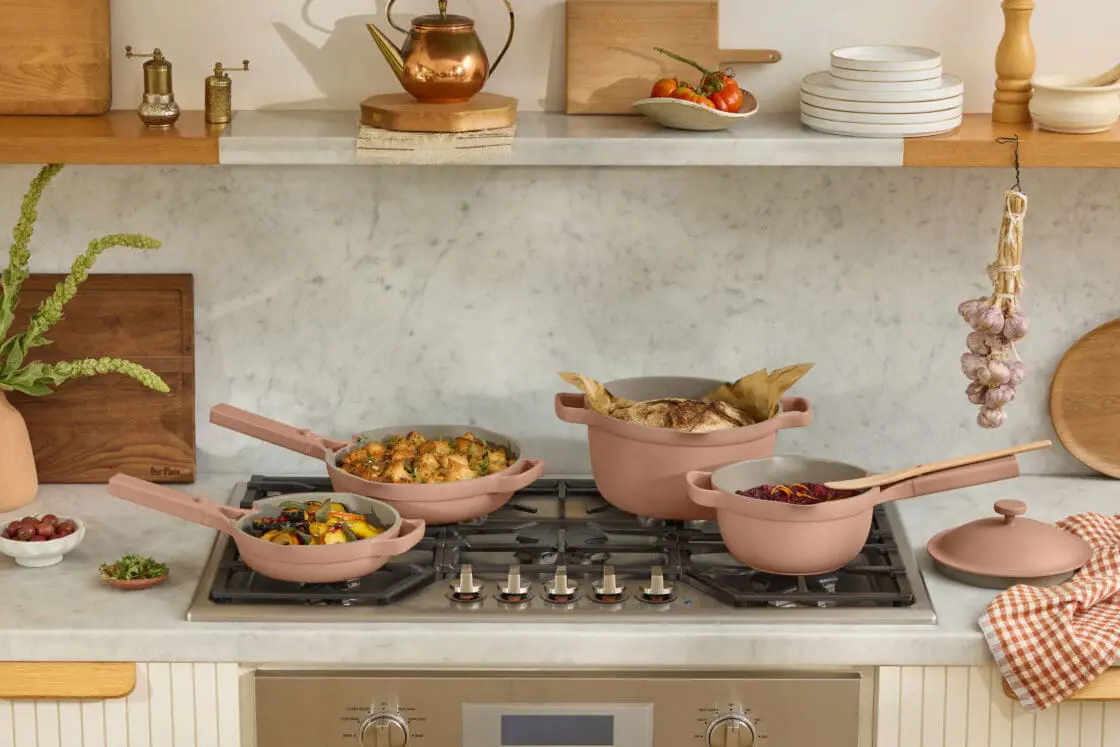
While Our Place continues to release newer collections like their Essentials line, they’ll always be best known for their classic cookware. The Cookware Set is made from 100% certified post-consumer recycled aluminum and features a solid cast aluminum core. This allows for more nuanced design elements like seamless surfaces and integrated pour spouts, all in one solid piece.
Aluminum is known for its fast heat conduction, meaning it will heat up and cool down quickly — which has both an upside and a downside. The downside is that it’s not ideal for keeping things warm after cooking for extended periods of time. However, it’s excellent for rapid sautéing and browning.
It’s also a light material, meaning more maneuverable pots and pans. This is great because the cookware is so versatile and gorgeous that you’re going to be moving it from stovetop to oven to table all the time. Plus, the handles on the Always Pan 2.0, Mini Always Pan 2.0, and Mini Perfect Pot 2.0 are made of stainless steel, which helps them stay cooler on the stovetop. However, note that the helper handles and the handles on the Perfect Pot are made of aluminum and do get hot. We always recommend hot pads when touching hot cookware, and that’s especially true with aluminum handles.
Last but not least, the cookware features Our Place’s advanced nonstick coating, Thermakind®. It’s mostly a sand derivative and water, making it as close to all natural as you can get. This non-toxic coating is free of PFAS, lead, and cadmium, and lasts 50% longer than their previous version of the pans. It also serves to encase the cookware’s core so your food doesn’t come into contact with aluminum.
For more details about the composition of Our Place’s cookware, you can read their California’s AB 1200 Disclosure.
Testing Our Place Always Pan 2.0 and Set
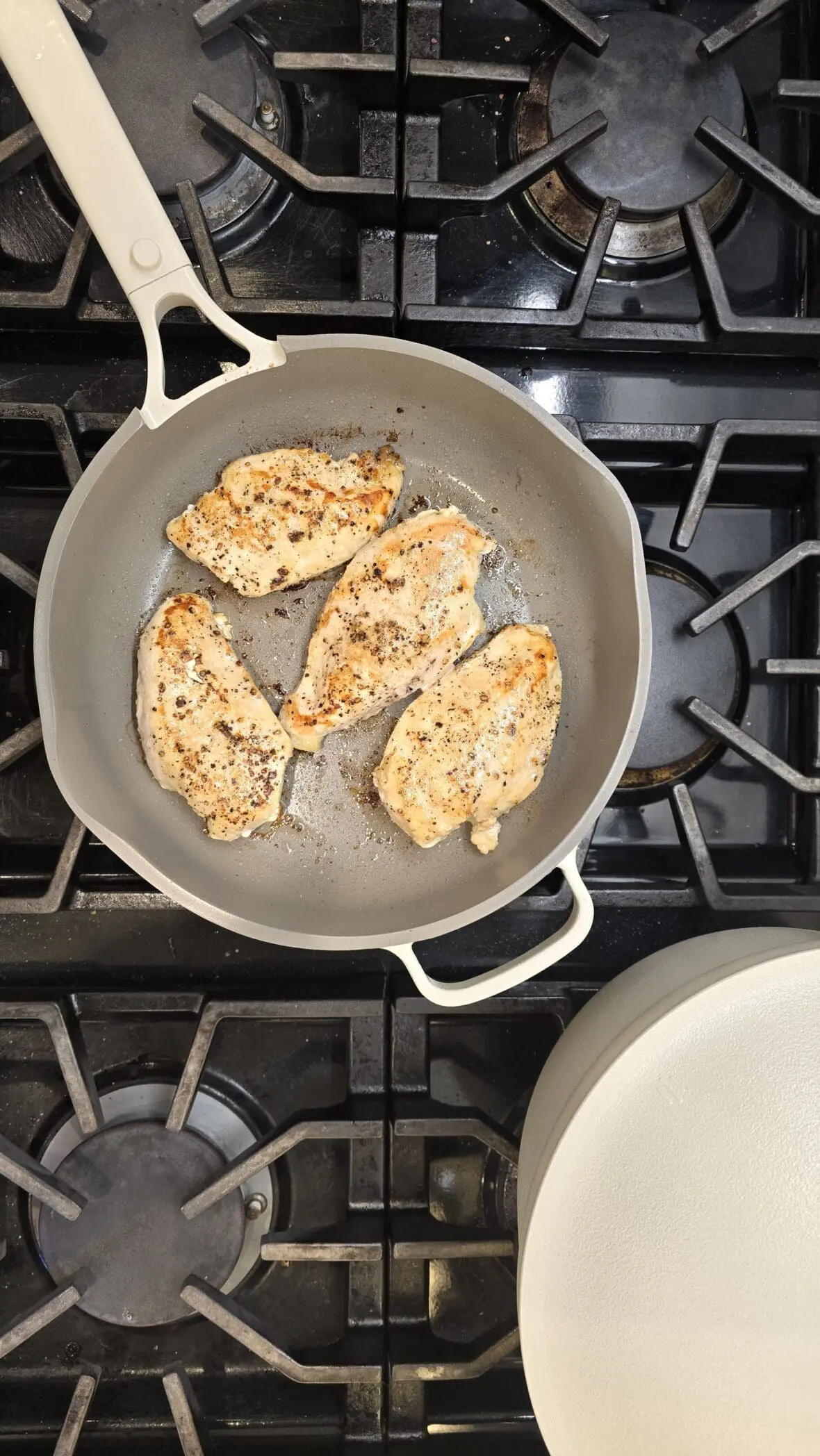
I’ve been cooking with Our Place’s Cookware Set for a little over a year now, and I’ve been pleasantly surprised by a few things. With light pots and pans, I’m usually wary of hot spots. It turns out I shouldn’t have worried. The Always Pan 2.0 surprised me with its even heat conductivity and excellent sautéeing, stir-frying, and browning capabilities. It quickly proved itself as an effective all-rounder set for home chefs.
Other features I love include the spouts on the cookware, which make it easy to pour out sauces and stews without spillage. The Perfect Pot lid even features a pasta strainer. The square edges on the Always Pan 2.0 and Mini 2.0 handles are a little bulky (similar to a tennis racket), but the design makes it easy to slot the accompanying wooden spoon on it while you’re cooking.
These pots and pans are beautiful enough to showcase on your stovetop (my friends even commented on how stylish they are!). They come in 7 gorgeous matte colorways.
Anything else to be aware of? They’re not ideal for slow-cooking or serving dishes that need to stay hot (I’d recommend cast iron, pure ceramic, or stainless steel if your priority is heat retention). And of course, Our Place does also offer appliances like their 6-in-1 Wonder Oven Air Fryer or their new 8-in-1 Wonder Oven Pro if you’re looking for something more specialized. Finally, like other nonstick cookware, you do need to treat these pans with care — avoid stacking them or using metal utensils.
Stovetop Compatibility
Our Place cookware comes with a stainless steel plate on the bottom (which is good for heat conduction) and makes them compatible with all stovetops, including induction. The lids and pans are also oven-safe, but only up to 450°F (so no broiling, please).
Longevity + Durability
The Always Pan 2.0 collection has held up really well through all of my tests and recipe experiments over the past couple of years. Plus, the 2.0 versions of the Always Pan and Minis have been re-engineered, featuring a new Thermakind® nonstick coating made to last 50% longer. In other words, durability is top of mind for Our Place, too.
The Cleanup
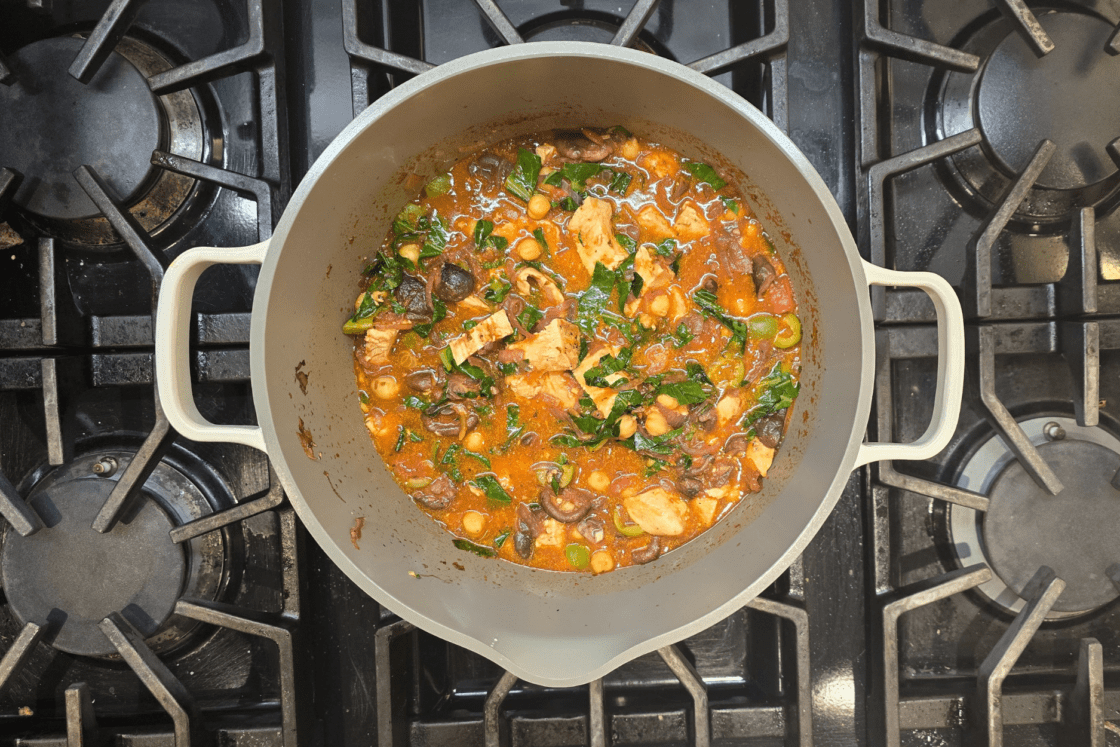
I can definitely testify that you never have to worry about cleanup when it comes to these pots and pans. The solid cast aluminum core means these pans don’t have rivets, which is more hygienic and easier to clean. They do require hand washing, but the nonstick coating makes it a breeze. No need to scrub or use abrasive cleaning agents — some soapy water and a sponge will do the trick!
| Pros | Cons |
|---|---|
| Fast and even heat conduction | Won’t last a lifetime |
| Cools quickly once removed from heat | Not dishwasher-safe |
| Easy to clean | Helper handles get hot quickly and require an oven mitt |
| No PFAS (PFOA, PTFE), lead, or cadmium | Not metal utensil-safe |
| Stovetop-agnostic (including induction) | |
| Oven-safe up to 450 degrees Fahrenheit |
What’s Included in the Our Place Cookware Set
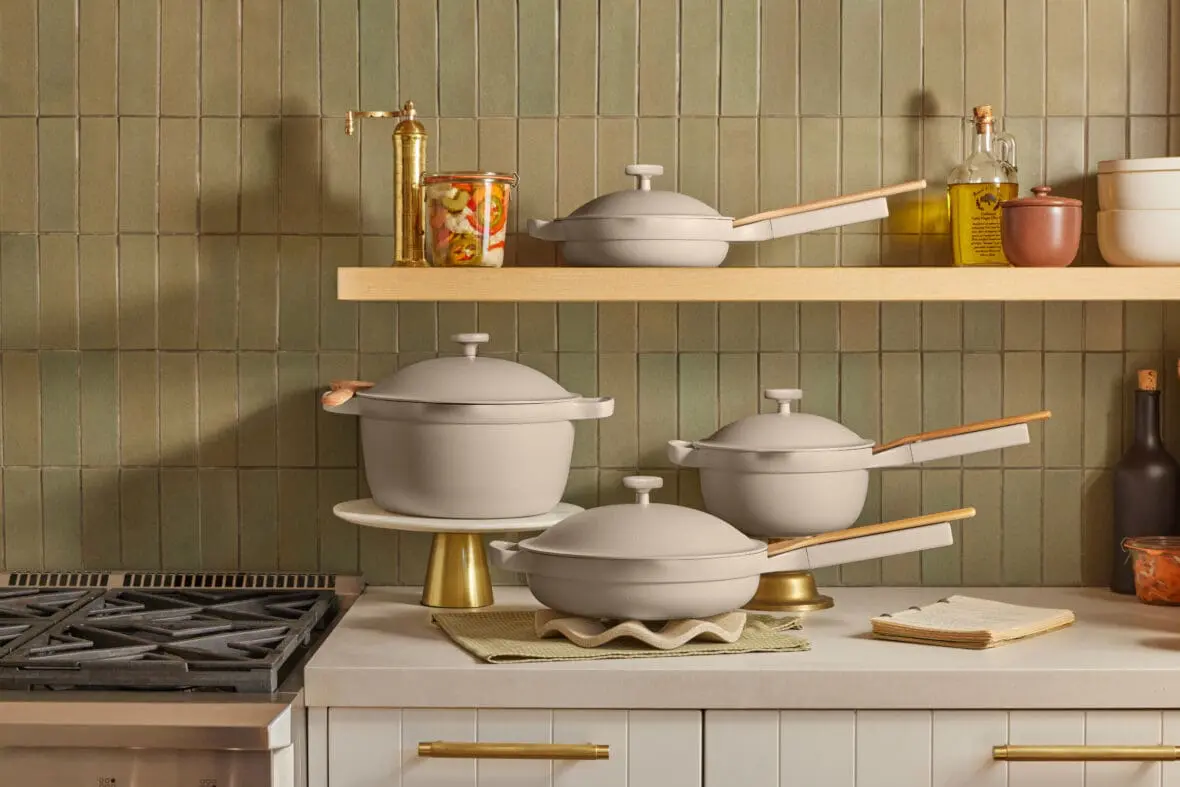
- Always Pan 2.0 (10.5-inch) with lid
- Perfect Pot (5.5-qt) with lid
- Mini Always Pan 2.0 (8.5-inch) with lid
- Mini Perfect Pot 2.0 (2.5-qt) with lid
- Stainless Steel Steamer Basket (9.7-inch diameter)
- Nesting Beechwood Spatula (Set of 2)
- Nesting Beechwood Spoon (Set of 2)
Available in 7 colors: Spice, Blue Salt, Steam, Cream, Sage, Char, Lavender
Price: $518 $315 at time of publish
More Options
If you’re not ready to commit to a full set, you can dip your toe in with individual pieces or the Home Cook Duo. The duo includes the Always Pan 2.0 and Perfect Pot, and still comes with the steamer basket, beechwood spoon, and spatula.
The Titanium Always Pan Pro: “Non-Nonstick”
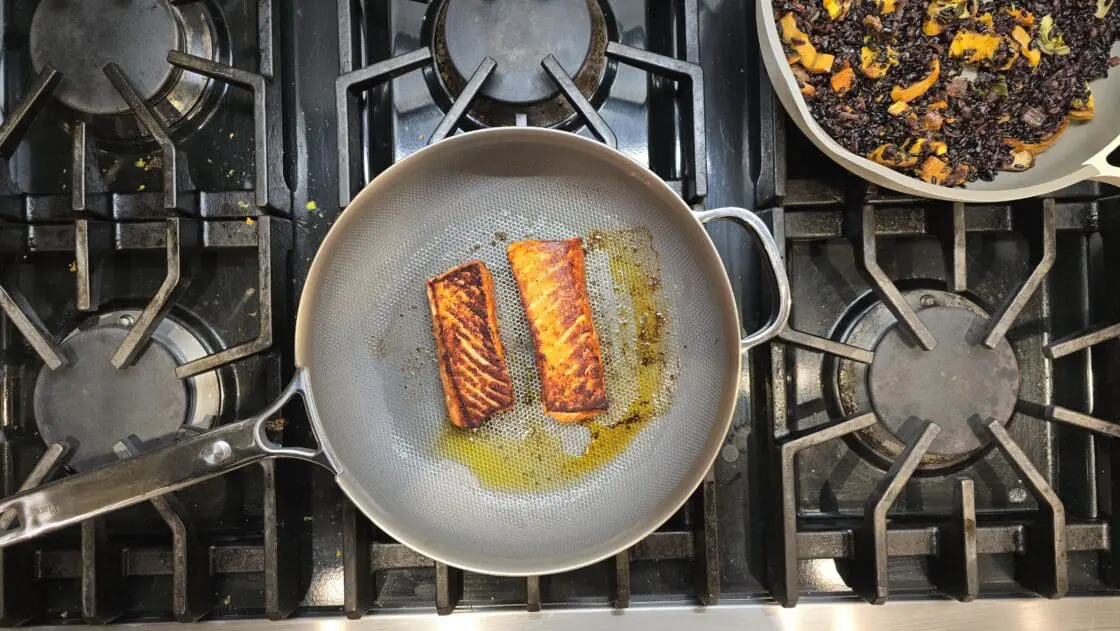
I couldn’t help but include a shout-out for the Titanium Always Pan Pro. If you want cookware that’s naturally nonstick without a coating — in other words, a “non-nonstick” — this is for you. It’s the first-ever nonstick technology that’s both PFAS-free and coating-free! To achieve the natural nonstick properties, you just need to properly preheat this pan for a couple of minutes, then heat your cooking oil through before adding your food.

The construction of this pan is seriously impressive. It’s fully clad, which means it’s constructed with multiple layers of metal that extend through the whole pan (not just the bottom). The exterior is made of three layers of stainless steel with an aluminum core for heat conduction, plus a durable titanium interior.
What’s the advantage of a titanium interior? It’s much stronger than a coating and 300% harder than stainless steel. It’s virtually indestructible and can withstand temperatures up to a whopping 1000 degrees Fahrenheit.
You’re free to use metal utensils (which I love!), and it’s dishwasher-safe.
Price: $179 $145 (for the Standard size) at time of publish
4. Alva Cookware: Sustainable Ceramic Nonstick, Stainless Steel, Cast Iron, Carbon Steel
From our partner.
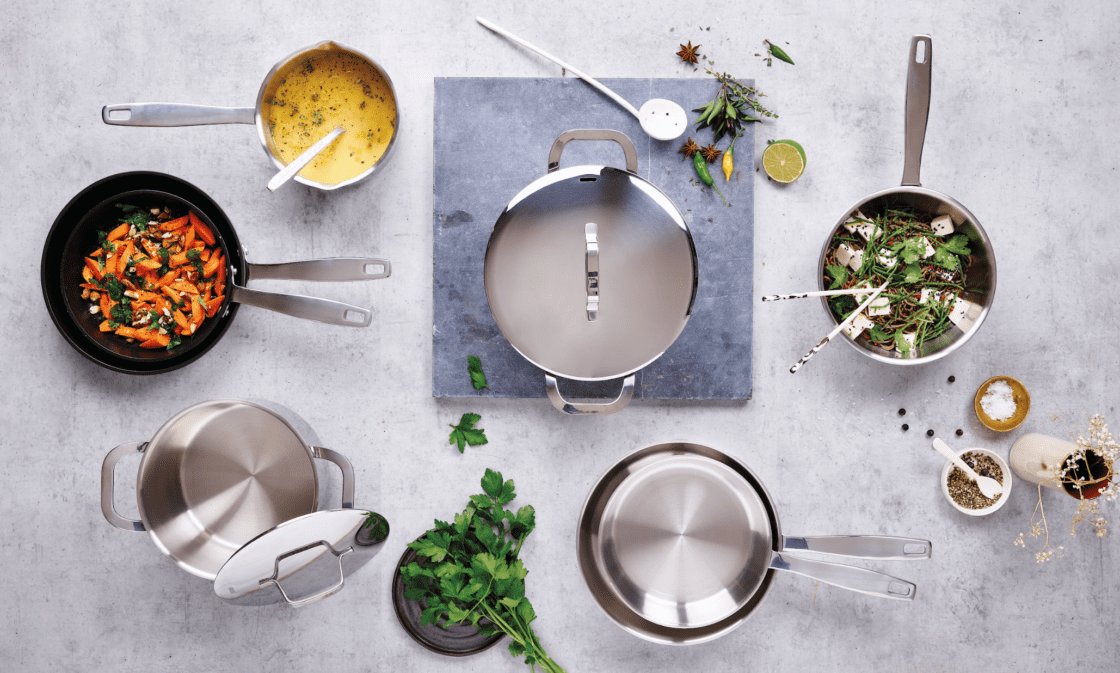
About Alva Cookware
The history of this legacy cookware brand is remarkable. Launched in post-WWII Belgium in 1949, Albert Vandaele started making aluminum cookware from scrap metal and discarded military equipment.
Fast forward to today, Alva Cookware is still a family-run business that is now expanding into the U.S. Alva’s collection is extensive and includes all the PFAS-free cookware you need, from ceramic-coated nonstick frypans to gorgeous stainless steel pots.
Alva Cookware Tested
I tested Alva’s ceramic nonstick Frying Pan and 5-ply Stainless Steel Frying Pan, both part of their signature Maestro cookware collection. Each of these pans can be purchased separately — but if you find yourself interested in both by the end of this review, you may want to consider the Maestro Essentials 9-Piece Set. You’ll be getting a great deal (and an extra saucepan, pot, skillet, and lids to boot).
The Maestro Ceramic Nonstick Frying Pan

This is a classic, ceramic-coated pan with slick nonstick capabilities. Sunny side-up eggs and delicate fish released easily from the pan over and over during my testing.
I love the straight sides on the pan, which give you 20% more cooking surface area. The thick, three-layer aluminum and stainless steel induction base ensures precise heat conduction.
The Maestro 5-Ply Stainless Steel Frying Pan

Alva’s stainless steel cookware is ideal for showing off medium to high-heat cooking techniques. This includes searing, browning, and caramelizing, all of which create texture and flavor that you don’t get without high heat.
The pan is made from five layers of SS304 18/10 stainless steel, and it also features those great straight sides like the Maestro ceramic nonstick pan. That means more room for your food to lay flat so you can properly sear, caramelize, and brown it.
The slightly curved handle rests perfectly in the palm of your hand, making it easy to move around the stove and kitchen. The sleek welded handles eliminate annoying food traps, and the 11” stainless steel pan comes with a helper handle that lets you maneuver the pan with both hands when you’re making large meals. Overall, I love the minimalist clean design of this pan.
How to Achieve Nonstick with Stainless Steel
Stainless steel is considered “non-nonstick,” in the sense that it doesn’t need a coating to achieve nonstick — but you still need to take some steps to prepare a slick surface. Start by preheating your pan for one minute over medium heat. Then add your oil or fat and preheat that for one minute before adding your food.
The Cleanup
Both the nonstick and the stainless steel pans clean up very easily. As with all my cookware, I wash these by hand to preserve the life of my pots and pans (hey, it’s expensive to replace!).
Durability
Alva’s ceramic nonstick comes with a 10-year warranty, which says a lot about their belief in the product. I’ve never seen such a long warranty on nonstick ceramic, so it’s a seriously impressive vote of confidence!
The stainless steel comes with a 25-year warranty, but these pans are made so well that I wouldn’t be surprised if they last a lifetime. Just be sure to care for them properly and you’ll be rewarded with many years of incredible searing and browning.
| Pros | Cons |
|---|---|
| No PFAS, lead, or cadmium | Not dishwasher-safe |
| Third-party tested | |
| Non-toxic ceramic nonstick coating | |
| 20% more usable cooking surface | |
| Heats quickly and retains heat | |
| 10-year warranty on Maestro nonstick (5-25 year warranty on others) | |
| Oven-safe up to 392°F | |
| Easy to clean | |
| Stovetop-agnostic |
What’s Included in a Set:
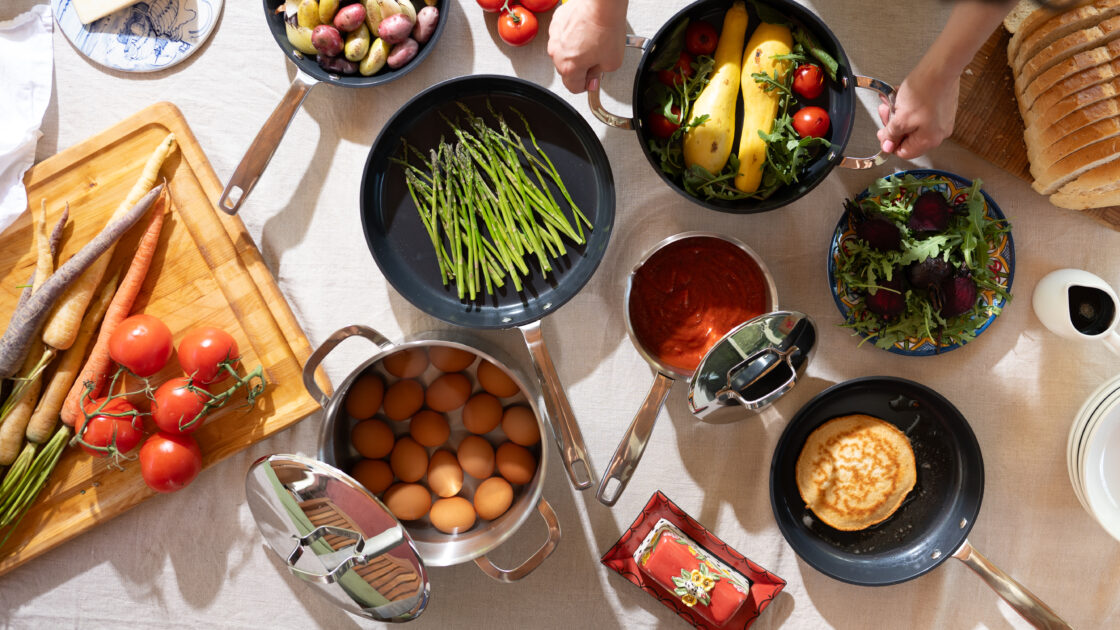
Maestro Essentials 9-Piece Set:
- 8-inch Maestro Nonstick Frying Pan
- 11-in. Maestro Nonstick Frying Pan with Lid
- 2-qt. Maestro Saucepan with Lid
- 4-qt. Maestro Sauté Pan with Lid
- 4.5-qt. Maestro Stockpot with Lid
Price: $870 $649 at time of publish
More Options
- Ceramic Nonstick: 11-in. Maestro Nonstick Frying Pan, Price: $199 at time of publish
- 5-Ply Frying Pan: 11-in. Maestro 5-Ply Frying Pan, Price: $179 at time of publish
Use the code ORGANIC10 to get an exclusive 10% off sitewide discount for our Organic Authority community!
5. Xtrema: Pure Ceramic Cookware
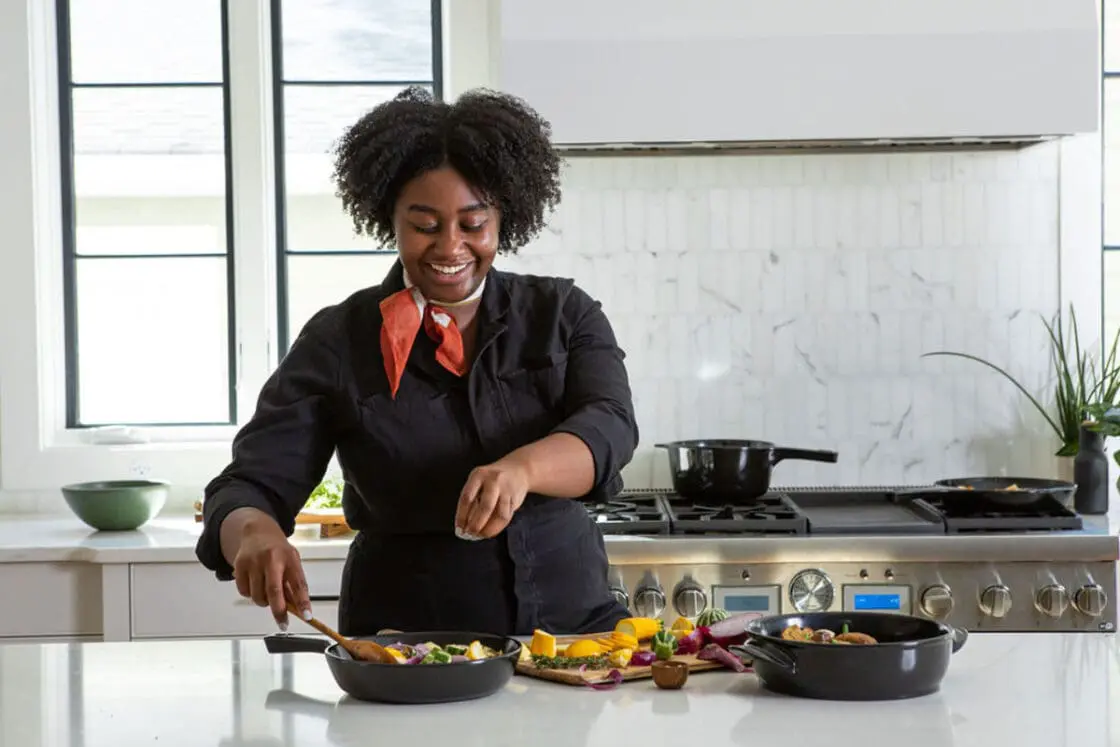
What Is Xtrema Cookware Made Of?
Xtrema’s pure ceramic construction (no metal core, no coatings!) is as close to the original clean cookware as you can get. It’s made with clay, water, natural minerals, and oxides.
As one of the few all-ceramic cookware lines on the market, it’s great for low and slow applications. Pure ceramic is probably one of the healthiest, and least toxic cookware materials you can find — it’s no wonder so many home chefs are making the switch. These pieces can go from the stovetop to the oven, they’re microwave-safe, and they’ve even made accessories for your air fryer! Xtrema makes the perfect vessel for one-pot recipes, as well as braising, boiling, and baking. You can even use it on the grill, and it’s safe to throw it in the dishwasher when you’re done.
Xtrema cookware is PFAS-free, FDA-approved, and meets California Prop 65 standards, meaning it’s free of more than 800 compounds and harmful chemicals that may cause cancer, birth defects, or reproductive harm. All of the products in this line come with a 10-year warranty, but it’s likely they’ll last well beyond that anyway.
Testing Xtrema
Xtrema is another cookware brand that I’ve been testing for at least 10 years. I’m a big fan of their Signature Skillet line.
I love, love, love making eggs in this pan. I was skeptical about its natural nonstick claims, considering it doesn’t have a nonstick coating. However, with a little oil or butter, you can create a surprisingly excellent nonstick surface. It’s also perfect for making Shakshuka and baked dips that go in the oven, like this spinach artichoke dip.
Since its initial release, they redesigned it with a one-piece construction that provides extra strength and durability. The 9.5-inch fry pan has the look and feel of a cast iron skillet without the weight or metallic taste. Or if you’re after a more nostalgic look, their new Founder’s Classic collection features gorgeous fluted detailing inspired by Ancient Greece. I’ve also tested their Classic Oval Dutch Oven, which is ideal for soups, stews, chilis, and breads. It’s a great option for anyone who’s tried a cast iron Dutch oven in the past and found it too heavy — this is a lighter alternative.
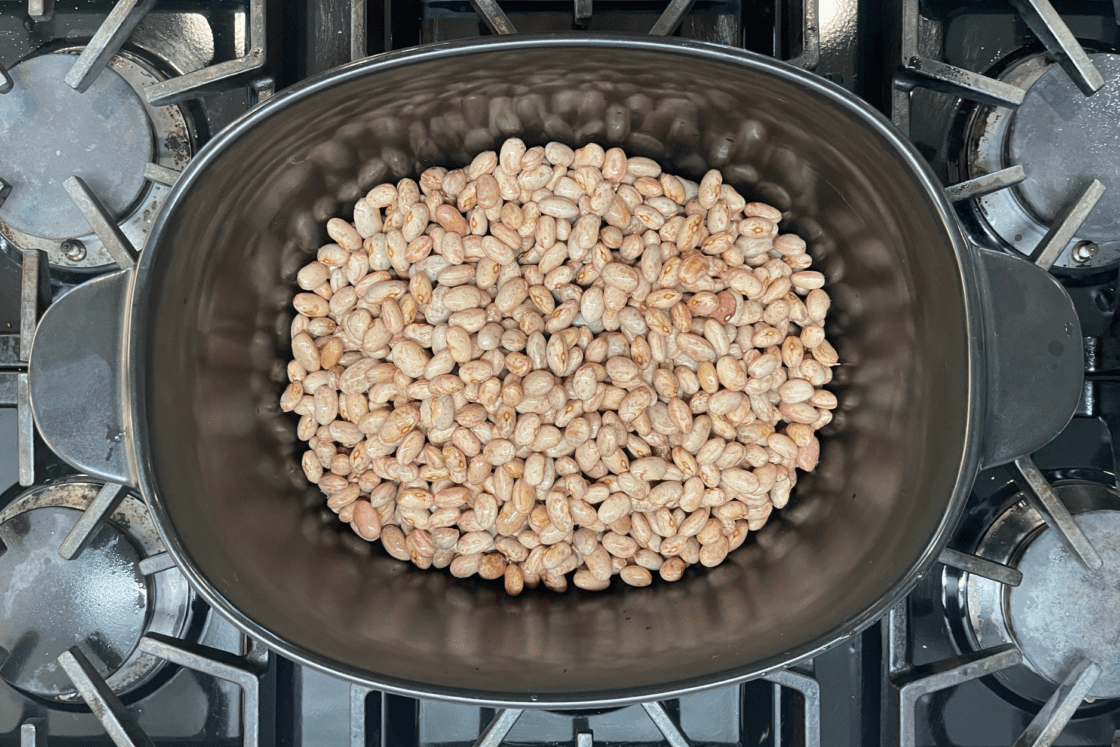
Xtrema’s Pots and Pans Have Ah-Mazing Heat Retention
– Credit: Laura Klein and Organic Authority Studio
Xtrema’s pans retain heat really, really well. When I cook with these pots and pans, I generally use a lower temperature because they hold heat so well once heated. When I cook a big pot of beans or chili in the Dutch oven, the pot will still have a slight simmer in it 20 minutes after I turn off the heat.
The Cleanup
Even though Xtrema’s pots and pans don’t have a coating, they are relatively easy to clean. All I ever need is some soap, water and a soft brush. If anything gets stuck, I put some water in it, turn a burner on low to heat it up, and gently use a wooden spoon to remove any stuck-on bits. I find this is the most effective method, but they’re also dishwasher-safe for those that prefer convenience.
| Pros | Cons |
|---|---|
| 100% pure ceramic | Have to preheat over low heat |
| FDA Certified and California Prop 65-compliant | Requires a special induction disk to cook on induction |
| No PFAS (including PTFE and PFOA), lead, or cadmium | |
| 10-year warranty and 40-day trial | |
| Dishwasher-, microwave-, BBQ-, freezer-, oven-safe | |
| Excellent heat retention |
What’s Included in a Signature Series Set

- 1-Quart Traditions Saucepan with Lid
- 1.5-Quart Traditions Saucepan with Lid
- 2.5-Quart Traditions Saucepan with Lid
- 9-inch Signature Skillet
- 100% Organic Cotton Handle Potholder (x2)
Price: $580 $464 at time of publish
Exclusive code: Use code OA15 to save an extra 15% off your order at checkout.
6 and 7. Made In Cookware: CeramiClad™ Nonstick, Carbon Steel, and Stainless Steel Cookware
This family-owned brand is 100+ years in the making, and the team and I are seriously impressed by the superior restaurant-grade quality of Made In’s 5-ply stainless steel clad and carbon steel pans. You can read our full review of Made In’s cookware here.
The CeramiClad™ Nonstick Frying Pan
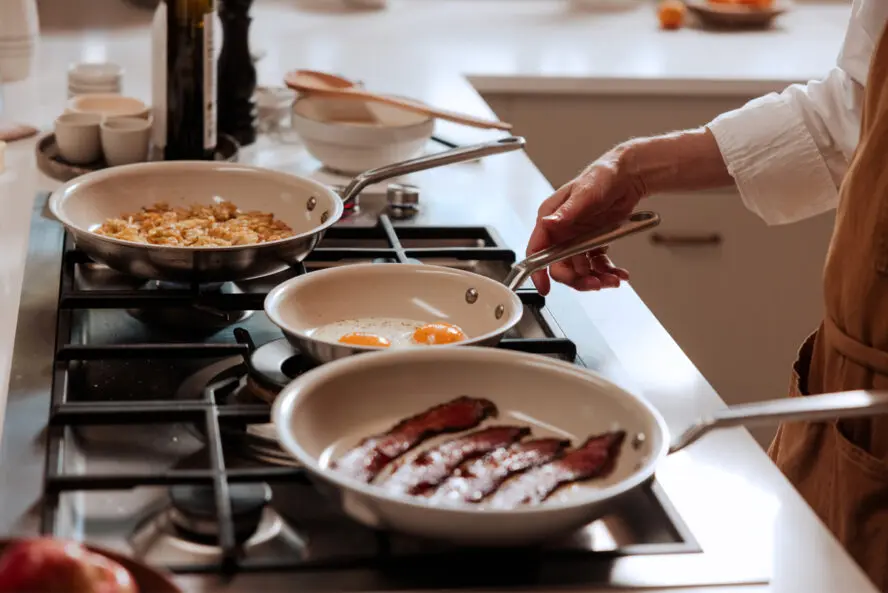
In 2024, Made In released their version of non-toxic, ceramic-coated nonstick cookware. How is it different from others on the market? It’s the first silicone-based coating (made without fluoropolymers and PFAS) that I’ve seen made in the USA (Wisconsin, to be exact)!
Simply put, it combines their award-winning 5-ply Stainless Clad Frying Pan with a proudly American-made ceramic nonstick coating.
CeramiClad™ Tested
Just like their traditional stainless steel cookware, this pan heats evenly without any hot spots. It also features Made In’s Stay-Cool Handle, which is hollow and dissipates heat. It fits snugly in the hand and is long enough to keep your distance from a hot stove (although we still recommend using a dish towel or oven mitt).
Another feature I loved while testing was this CeramiClad™ pan’s wide base and curved sides, which make it easy to flip your food. I tested eggs, pancakes, and fish, and they all easily slid up the curved sides and onto a plate, even without much oil. It’s also oven-safe up to 550 degrees Fahrenheit, so you can throw it in the oven for easy roasting and broiling.
The Cleanup
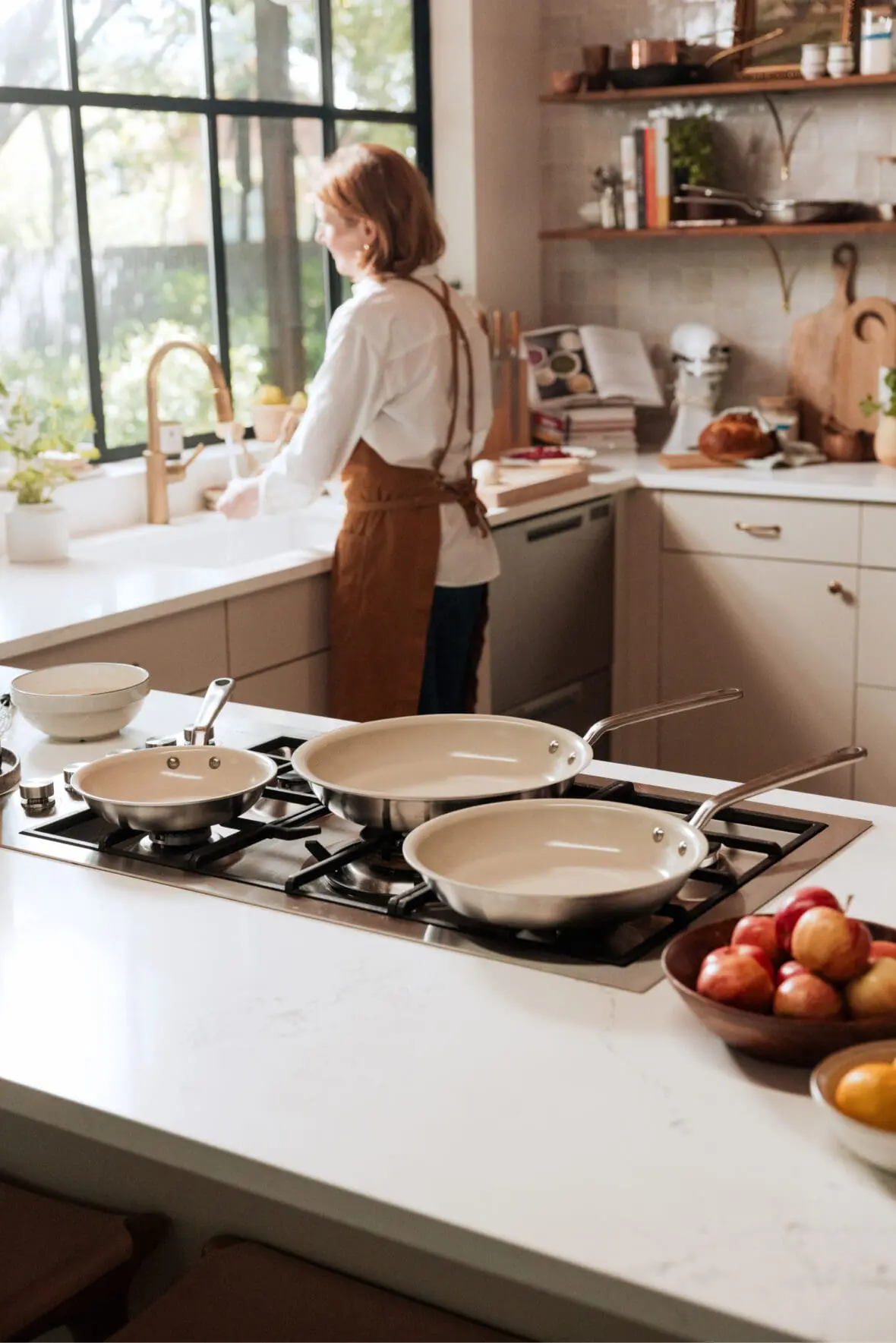
Like any other ceramic nonstick cookware, you should use this pan for medium-heat cooking, wash by hand, and stay away from abrasives and metal utensils.
Avoid stacking your pots and pans when storing (or use a dish towel to prevent scratches).
Durability
When it comes to durability, this pan’s 5-ply Stainless Clad interior gives me a lot of confidence.
Its longevity will depend on giving the nonstick exterior the proper care, but overall this feels like another high-quality Made In product.
What’s Included in a Set
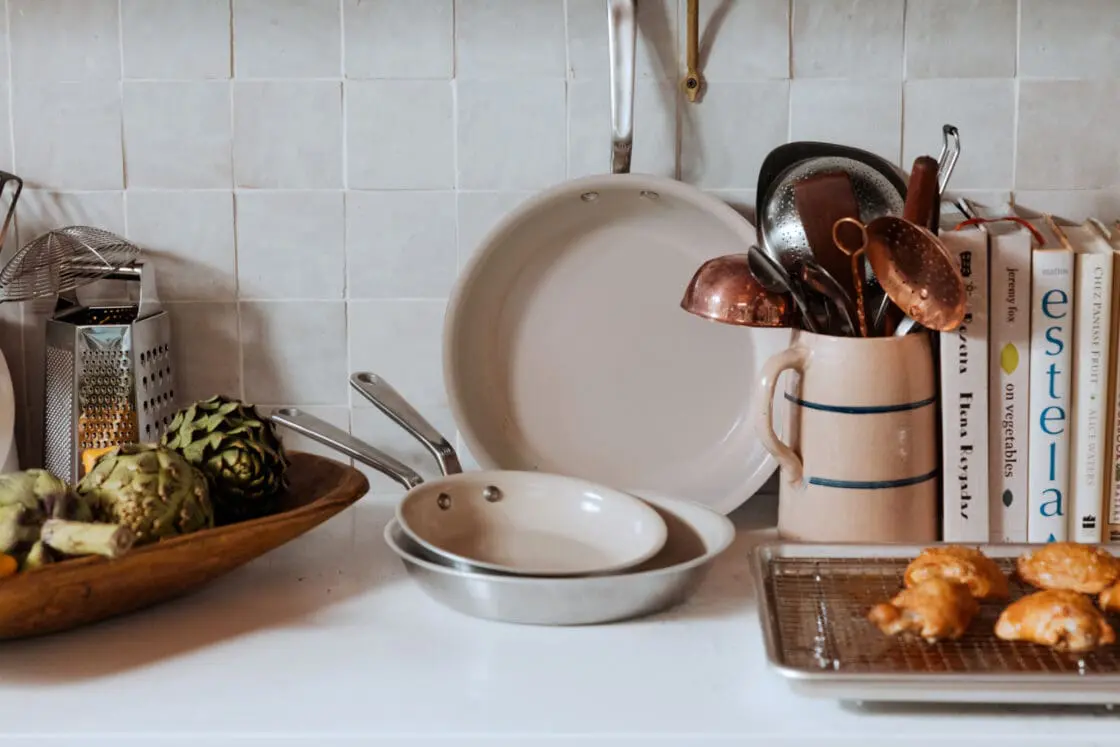
CeramiClad™ Nonstick Frying Pan 3-piece Set:
- 8-in. Nonstick Frying Pan
- 10-in. Nonstick Frying Pan
- 12-in. Nonstick Frying Pan
Price: $447 $349 at time of publish
Made In’s Carbon Steel Pots and Pans Construction
Their carbon steel cookware line is another absolute favorite of mine. You can think of carbon steel as a cross between stainless steel and cast iron. It’s lighter and easier to maneuver than a cast iron skillet, and excels at high-heat cooking techniques. It heats up and cools quickly, and easily goes from stovetop to oven. It’s also kind of indestructible — you can even take it camping.

Carbon Steel Tested
I’ve used the 12” carbon steel non-toxic skillet for everything from roasting whole chickens to baking a chicken pot pie. I’ve even cooked eggs in it with ease after building up a nice seasoning in the pan (read more about a failsafe method to keep eggs and fish from sticking). I’ve also thrown it on the grill to cook up vegetables. Its versatility is endless.
You can buy the carbon steel pan preseasoned or unseasoned. I went for the unseasoned option — the pan will become seasoned with use and develop natural nonstick properties as you go. Avoid cooking acidic foods like lemons, tomatoes, and wine, which can strip the natural seasoning. But if it does get stripped, you can easily reseason the pan.
Made In’s Stainless Steel Cookware Construction

Made In’s stainless steel cookware is constructed with five layers of metals for improved heat conduction, making it an extremely durable kitchen staple. The frying pans’ rolled rims are a nice added touch that allow you to pour liquids without spilling. And they’re oven-safe up to a whopping 800 degrees Fahrenheit, so you can easily go from stovetop to oven.
Stainless Clad Tested
I’ve tested everything in these pans — from roasting a whole chicken in the oven to executing blistered greens, caramelized Brussels sprouts, and perfectly-seared grass-fed pieces of meat (I love that extra flavor and texture that you get from caramelization).
The 5-ply stainless steel is surprisingly lightweight, which makes it easy to flip ingredients and transport from stovetop to oven. The long stay-cool handle and curved lip makes it easy to pour pan sauces over hot finished dishes.
The Cleanup
The stainless steel cleans up easily with some soap and water. They’re also dishwasher-safe, but as with most of my pans, I wash by hand for longevity. When it comes to the carbon steel, I’ve developed a nice seasoning on my pans, so the cleanup has been easy.
Whenever I’ve had to deal with some burned-on bits, there are a couple of different ways I handle it. One option is to use this mesh chain mail scrubber that I absolutely love. Otherwise, I put some water in the pan and put it over low heat. Once heated through, I run a wooden spoon across the bottom of it to lift the stuck-on bits of food. Just don’t leave your carbon steel pan soaking for long in a soapy bath — that’s a recipe for rust.
| Pros | Cons |
|---|---|
| Michelin star chef-approved stainless and carbon steel cookware | Made In’s nonstick pan is PTFE (which is why we haven’t included it on this list ) |
| Carbon steel builds natural nonstick with use | Stainless steel is not naturally nonstick |
| High heat capacity | |
| Extremely durable | |
| Stainless steel oven is safe up to 800°F, carbon steel 1200°F | |
| Induction compatible | |
| Limited lifetime warranty |
Made In Cookware Specs
Stainless steel frying pan comes in 6, 8, 10, 12-inch options.
Price: $119*-$139*, depending on pan size
Carbon steel frying pan comes in 8, 10, 12-inch options. Choose from seasoned or unseasoned.
Price: $99*-$129*, depending on pan size
8. Staub: Enamel-Coated Cast Iron Cookware
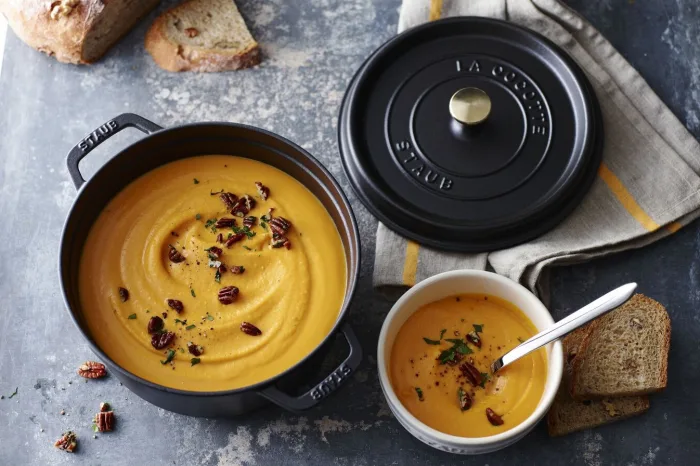
“I always recommend Staub pots and pans because when you buy them you know you’re getting quality. They are very good at keeping moisture inside the pot during a long braise, which means you’ll have a more flavorful stew.”
Devan Cameron, Chef and Owner of Braised & Deglazed
About Staub Cookware, Loved by the Pros
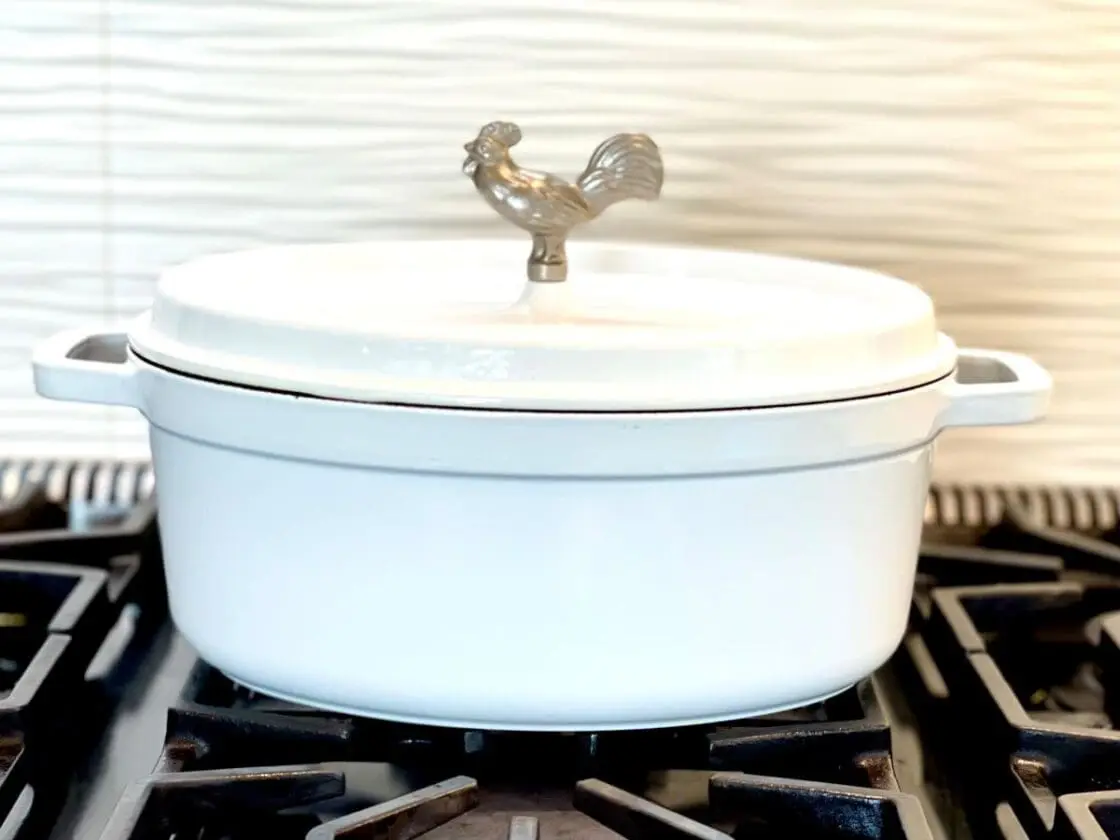
Over the last five decades, Staub has built a legendary reputation as a French culinary favorite for enameled cast iron. Originally developed in part with the famed French chef Paul Bocuse, this heavy-duty cookware boasts the phenomenal heat retention of cast iron and the acid-resistant, slick surface of glass enamel studded with quartz crystals. It stands up to metal utensils, and it’s oven-safe up to 500°F.
Staub Tested
I’ve been testing Staub’s enamel-coated cast iron for years, and I love it. Many ask if I prefer it over Le Creuset, and my personal answer is yes (visit my full comparison of Staub vs. Le Creuset Dutch ovens for the breakdown).
Why? The black matte enamel cooking surface made from glass and quartz crystals is unique amongst enamel-coated cast iron brands. It requires no seasoning and stands up to heavy metal utensil use (Le Creuset does not). I also find that the texture means it sears meat and vegetables much better than Le Creuset.
When I cook with Le Creuset, I find that the cream enamel coating is more delicate. Some people prefer the visibility that a light interior offers, but I find it turns brown with use, doesn’t stand up to metal utensil use, and develops fine cracks over time.
I’ve made everything from steaks to slow-cooked soups, stews, beans, and chilis in my Staub Dutch oven, and it passed all my tests with flying colors. Veg and meat seared easily, creating excellent caramelization that left tasty browned bits behind — perfect for making delicious pan sauces. Its smooth enamel bottom works on all stovetops, including induction. All that said, it’s not without some minor downsides. Like all cast iron cookware, it’s heavy (ever tried to flip an egg in a cast iron skillet?) and it does take longer to fully heat through (Hot Tip: You can put it in the oven to facilitate even heating).
A special callout for Staub’s innovative lid design: This lid is a dream. It offers a snug fit to trap condensation, and it features smart self-basting spikes all along the inner surface to ensure moisture drips back into the dish during slow cooks. The superior steam retention makes it especially great for bread — it produces tender and moist sourdough with a sublimely crisp crust.
Cleaning Staub
While testing I also found that Staub was easier to clean than Le Creuset. Le Creuset is tougher to keep clean because of the cream-colored enamel coating. I was constantly trying to scrub away the brown left behind after I cooked, and I finally gave up after testing Staub.
I sat down with Joanna Rosenberg from Staub for an Instagram Live conversation to cover a full review of what makes Staub stand out from the rest (you can also read our interview and review of Staub here).
| Pros | Cons |
|---|---|
| Stovetop-agnostic | Pricey |
| Metal utensil-tolerant | |
| Textured black matte interior delivers an incredible sear and doesn’t turn brown over time | |
| No seasoning required | |
| Easy to clean and dishwasher-safe (though hand washing is recommended) | |
| Innovative lid design |
Tested Dutch Oven Specs:
Price: 5.75 qt, oval, Cocotte: $379.99*
*Note! There are tons of sizes, shapes and colors to choose from. This cocotte is just one size. And you can find some great skillets.
Cast iron was made for slow, anti-inflammatory cooking. Tell our Meal Planner your health goals and get recipes built around them →
9. Demeyere: Premium Stainless Steel Cookware
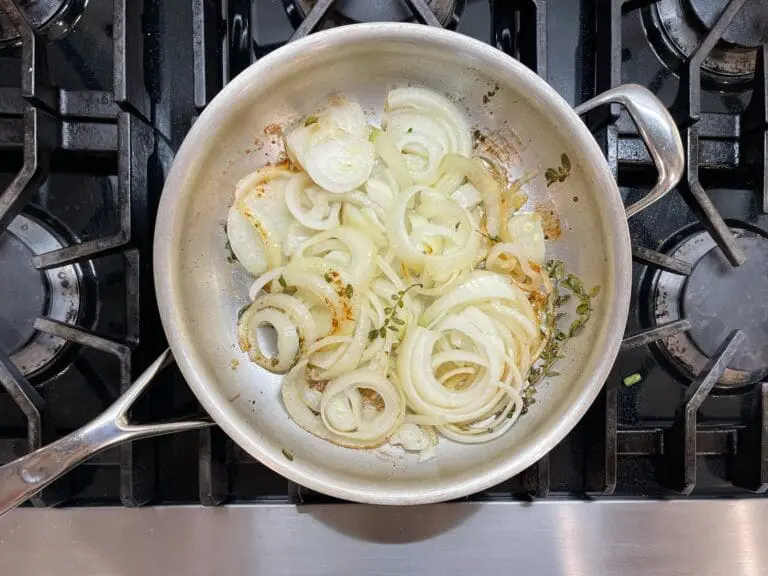
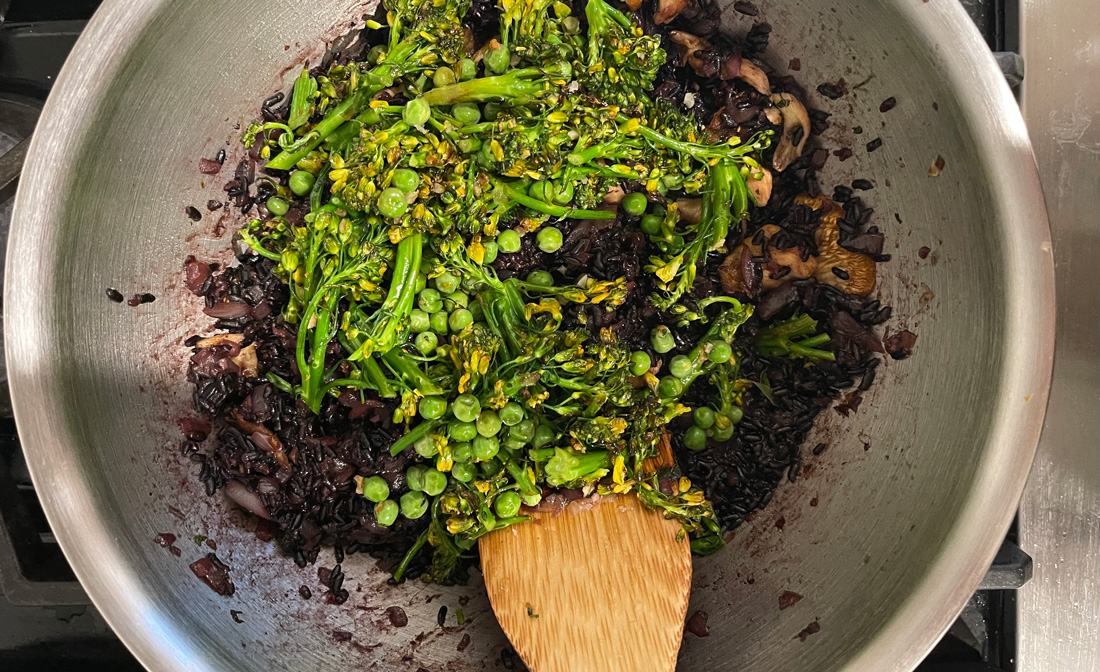
“I use the saucier for so many things, like making weeknight tomato sauces, rice, quinoa, melting chocolate, and caramelizing onions.”
Laura Klein
Belgian family-run Demeyere has been a benchmark in stainless steel cookware for over a century. Its outstanding feature? Silvinox technology — a unique electrochemical surface treatment (not a coating!) that enriches and purifies the stainless steel surface, making it easier to clean and allowing it to retain its shine and silver-white color. Over time I’ve found that a bit of Bar Keeper’s Friend also goes a long way in keeping them shiny.
About Demeyere Stainless Steel Construction
I seriously love these frying pans for their excellent heat conduction and easy-to-clean surface. I’ve tested the Atlantis, made with seven layers of metal, and the Industry 5, with five layers. Both have excellent conduction, eliminating hot spots.
If heavy cookware is a challenge for you, the Industry 5 may be a better choice. The Atlantis is a heavier pot (or pan) with its seven layers. However, the 11” and 12.5” come with helper handles, which help overcome their hefty weight.
These non-toxic pans don’t contain rivets, eliminating any risk of food getting stuck in small crevices and making them more hygienic overall. They also feature a proprietary flat-bottom technology that keeps the pans from warping at high temperatures.
Demeyere is definitely one of the pricier options in this guide, but their list of pros is pretty impressive. Plus, the Demeyere Atlantis set comes with a Dutch oven and saucier (when it’s in stock!), which adds great value. We’ve never seen a cookware set include that specific combination of pots and pans — they’re usually add-ons.
Testing Demeyere
Because the Atlantis has seven layers of metal, it does take longer to heat up. However, when fully heated, it’s excellent at conducting heat and browning items like potatoes, vegetables, and even pancakes with gorgeous crispy edges. Its many layers also mean it’s more forgiving at a high cooking temperature, where something like the carbon steel or a pan with fewer layers is not.
Favorite Features
One of my favorite features of the Atlantis collection is the wide bottom of the frying pan. It gives you more cooking surface area to brown your food in a single layer, helping reduce the number of pans you may use (and the number of dishes you have to wash later).
The rounded edges of these cookware sets make pouring sauces over finished veg and meat a breeze. The long handles keep your hand away from the stovetop heat source and make them easier to reach for in a heated oven (with an oven mitt of course!). They’re also metal utensil-safe, too.
If you have an induction stovetop, you may want to go for the Atlantis set. At the time of this update, that cookware set comes with TriplInduc® technology, which Demeyere claims is 30% more efficient on induction.
“The Demeyere Atlantis comes with a little more weight with the two extra layers, but the superior heat conduction retention, food release, easy-to-clean cooking surface and overall design and feel of the pan in my opinion, is worth it.”
Laura Klein
Cleaning Demeyere Stainless Steel Pots & Pans
These stainless steel pans have excellent food release, making them easier to clean than a traditional stainless steel pan. I wash them by hand, but they are dishwasher-safe.
| Pros | Cons |
|---|---|
| 7-ply stainless steel InductSeal® base with copper disk | Pricey |
| Thick aluminum core | |
| Dishwasher-safe, easy to clean | |
| Retains silver-white shine for years due to the Silvinox treatment | |
| Excellent heat conduction and browning | |
| Induction-compatible | |
| Lifetime warranty | |
| No rivets | |
| Chef favorite |
What’s Included in a Demeyere Atlantis 9-piece Cookware set:
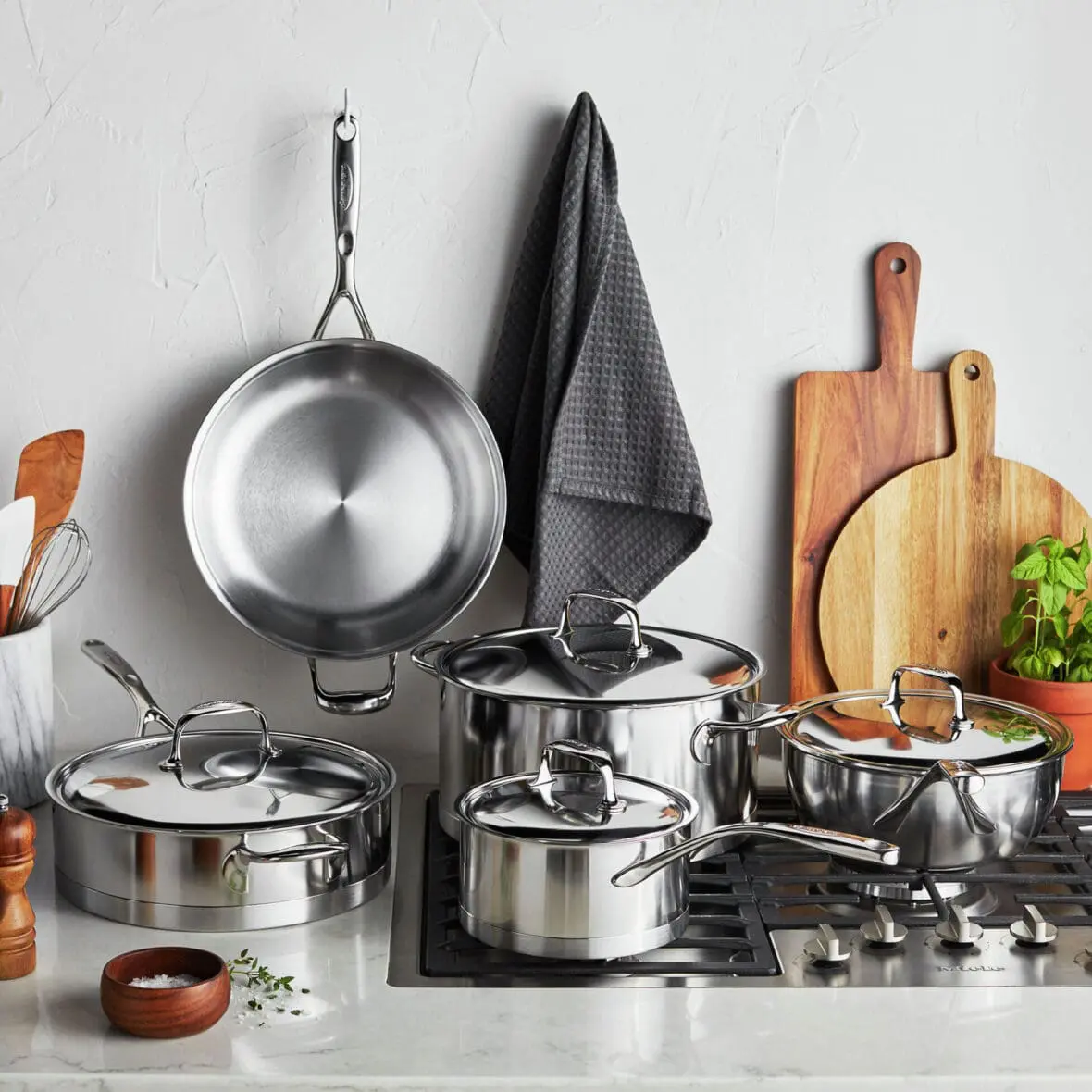
- 11-inch fry pan
- 3.5-quart saucier + lid (excellent value!)
- 5.1-quart saute pan with helper handle + lid
- 2.3-quart saucepan with + lid
- 8.9-quart Dutch oven with lid (excellent value!)
Price: $1399.99 at time of publish + 15% off when you sign up for the newsletter
Choosing the Right, Safe, Cookware for You
Where to start? We recommend beginning with a base set and adding from there. And to make things even easier, follow our chart to select the perfect pieces for your non-toxic cookware collection.
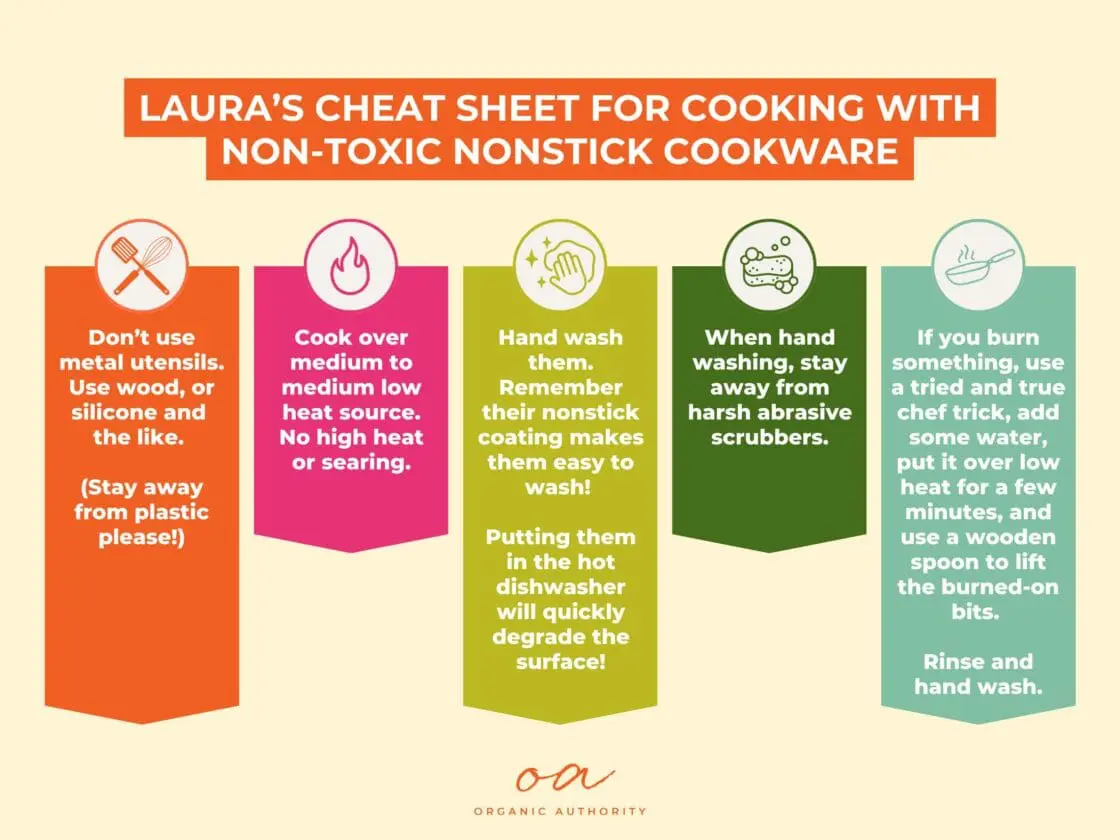
My 5 Tips for Making Your Non-Toxic Nonstick Cookware Last
If you’re looking for the perfect nonstick pan that’s not PTFE (or Teflon) and will last a lifetime, we’ll be the first to tell you — it doesn’t exist. In fact, no nonstick cookware lasts a lifetime. And the reality is that non-toxic ceramic-coated pans won’t last as long as their PTFE competitors (AKA toxic pans). But eventually, they’ll all fail — it’s the nature of the material.

What I can tell you is that I’ve been testing non-toxic, nonstick cookware for more than a decade. If you’re thoughtful about how you use it, it will last you years. I have multiple non-toxic nonstick pans from different brands and manufacturers that are going on three to five years of use and still going strong. If you follow these simple tips, yours will last longer than you expected too.
Laura’s Cheat Sheet for Cooking with Non-Toxic Nonstick Cookware
The Healthiest Pots and Pans to Cook With
Now that we’ve gone through our top non-toxic cookware recommendations, let’s recap the various materials we’ve covered to help you make your final decision.
Pure Ceramic
If you’re looking to ditch toxic pots and pans, pure ceramic might just be the safest cookware material for your health. This type of cookware is made with just one material — ceramic — meaning it’s completely free of heavy metals and other contaminants. It conducts and retains heat very well, and it boasts a low carbon footprint as a nice cherry on top.
Best cooking technique to use: low and slow, stovetop to oven (to table).
Ceramic-Coated Cookware
It’s nonstick and doesn’t off-gas at high temperatures — win and win. When treated well it can last for several years, and it’s likely the best option if you’re looking for a non-toxic nonstick pan. The manufacturing process with this material is also more environmentally-friendly than traditional nonstick, as PFAS chemicals used in conventional nonstick production are under heavy scrutiny concerning public health issues1.
So what’s the catch with ceramic-coated cookware? Low-end brands can wear out quickly — some as soon as four weeks in. Basically, these cheap options end up being a complete waste of money, which is why we always recommend investing a bit more in a quality brand like the ones in this guide.
Best cooking techniques to use: medium to medium-low heat.
Stainless Steel
Stainless steel cookware is a tried-and-tested workhorse for professional and home kitchens alike because it can last a lifetime and take a beating. They’re also excellent for high-heat cooking techniques. Look for cookware brands that use food-grade 18/10 stainless steel with an aluminum core and employ third-party lab testing in compliance with Prop 652. Bonus: Stainless steel is metal utensil-safe.
Best cooking techniques to use: high-heat searing, stovetop to oven.
Enameled Cast Iron Cookware
An heirloom classic in the kitchen, cast iron pots and pans are durable enough to be passed down from generation to generation. They retain heat like a dream, deliver a masterful sear, and are metal utensil-safe. While cooking with this material is generally safe, those susceptible to iron overload should consult with their primary care physician and use cast iron cookware with caution.
Our preference is for enameled cast iron cookware, made with a glass black enamel surface studded with quartz particles.
Best cooking techniques to use: high-heat searing, stovetop to oven, grilling, anything that calls for excellent heat retention.
Heirloom cookware deserves heirloom-worthy meals. Get a free organic meal plan with searing, braising, and oven-to-table recipes built for your goals →
Frequently Asked Questions: Cookware Safety
Looking for a quick and easy answer to your *ahem* burning questions? Explore our answers to common questions below, or if there’s anything left unanswered feel free to leave a question for us in the comments below! And as always, if you have concerns, consult your primary care physician.
Yes, ceramic-coated nonstick cookware is considered a safe non-toxic option. They’re made entirely without PFAS chemicals, which are used in the production process for traditional PTFE-based nonstick cookware.
While research regarding the detrimental effects of cooking with aluminum is inconclusive, there are concerns over aluminum leaching into food when in contact with acidic foods (tomatoes, vinegar, wine).
To avoid this, stay away from aluminum cookware that is cheaply made or secondhand, and you should stick with reputable brands that follow safe manufacturing practices10. Leaching is also not a concern for aluminum-based cookware that is coated or treated (anodized).
Copper is considered a heavy metal and is highly reactive to acidic foods like tomatoes and vinegar11. Copper cookware is typically lined with stainless steel to prevent leaching, but there is a concern that individuals with nickel sensitivity (about 10% of the population, as reported by Cleveland Clinic) should avoid stainless steel12. For those without a nickel allergy, it’s still best to choose reputable brands that use food grade 18/10 stainless steel or higher to line their cookware.
Stainless steel has long been a favorite of pro chefs thanks to its durability and high-heat capabilities. While stainless steel is generally safe to cook with, there is some concern over nickel leaching when in contact with acidic foods (tomatoes, vinegar). Again, this is mostly a concern for individuals with nickel sensitivity13, but you should always choose reputable brands that use food-grade stainless steel.
Enamel is often used to coat cast iron and offers a safe way to add a surface that doesn’t require seasoning. Look for brands that conduct third-party lab tests to ensure Prop 65 compliance for cadmium and lead.
Yes, carbon steel is generally safe to cook with. Carbon steel is a mix of cast iron and stainless steel that usually comes as uncoated material (unless it comes pre-seasoned). It can handle high cooking temperatures without breaking down or off-gassing toxic fumes (unlike PTFE-based nonstick coatings).
Similar to uncoated cast iron, avoid long simmering meals with acidic ingredients, as this may strip the natural seasoning and leach trace amounts of iron into your food. If you have any potential concerns associated with iron exposure, consult your primary care physician.
Yes, cast iron is generally a safe cooking material, although it’s similar to carbon steel in the sense that contact with certain acidic foods may cause trace amounts of iron to leach into your food. This may not be healthy for individuals susceptible to iron overload14, so it’s worth speaking to your PCP if this may be you. Enamel-coated cast iron comes sealed and is less likely to leach.
Cooking with PTFE-based cookware is generally considered safe, but it can quickly become toxic. Overheating can cause your pans to off-gas toxic fumes that lead to flu-like symptoms3. Beyond your personal health, PTFE pans have a significant negative impact on the environment because of their use of “forever chemicals.” The cookware industry has a long history of litigation with regard to localized PFAS contamination in local waterways — a serious public health concern that we’ll be dealing with for, well, forever1.
While it is possible for a company to make safe PTFE cookware, we have not encountered a cookware brand that can answer my questions with regard to their wastewater mitigation practices. For this reason, we much prefer ceramic cookware, as it eliminates the need for toxic PFAS chemicals altogether.
Brands and Products We Don’t Recommend and Why
We previously recommended PTFE-free nonstick pans from Ecolution’s Bliss Line, Ozeri Green Earth, GreenLife Soft Grip, and Cuisinart’s Green Gourmet 12-piece set. But we’re walking that back, and for good reason. These pans simply don’t hold up to our standards for durability and high-heat cooking capabilities.
Similarly, there are also other brands we’d recommend that haven’t made it onto this list. For example, Lodge skillets are a great value option that’s definitely worthy of consideration.
My Expertise
I’m a professionally-trained chef that completed culinary school in Los Angeles. I’ve been testing non-toxic cookware for over ten years. I’ve tested each and every one of the pots and pans in this guide for months, and many for years. I’m also a recipe developer and writer, and I launched Organic Authority after I completed culinary school.
While in school, we learned how America’s food is grown by Big Agriculture, using toxic pesticides, chemicals, and the horrific conditions of confined animal feeding operations. This inspired a paradigm shift for me, and I realized how America’s “healthy food” was directly related to its burgeoning obesity and health epidemic. That’s when I decided to launch Organic Authority, because I felt America needed to know the truth behind their food supply.
To stay in touch with me, sign up for our newsletter here.
Final Thoughts
At the end of the day, there’s no shortage of options of incredible non-toxic cookware — so there’s really no excuse to be using PFAS-laden pans in 2026. And no matter what your needs are in the kitchen, we guarantee there’s a great non-toxic collection for you.
If you want the convenience of nonstick cookware, go for PFAS-free ceramic nonstick. We recommend GreenPan, Caraway, Our Place, Alva Cookware, or Made In. Note that there is a trade-off — no nonstick will last forever, so these aren’t heirloom pieces. But we certainly think that sacrifice is worth it for the toxin-free ease of ceramic nonstick.
However, if your priority is longevity and you also want the flexibility of being able to execute different cooking techniques with different materials, don’t feel limited to nonstick cookware! For techniques like high-heat searing, you may want to consider stainless steel, carbon steel, or cast iron (which is also great for slow cooking, if you don’t mind the heft of it). These options do contain metals, which may not be for everyone, but they’re highly durable and also PFAS-free.
Whatever you choose, here’s the bottom line: you don’t have to settle for cookware that’s full of toxic chemicals.
We frequently add or remove products based on our research and testing. Please let us know in the comments below of any brands you’d like us to look into or if you’d like to share your own experiences with the brands you’ve tried.
Read More on Safe Cookware
*Organic Authority received compensation for this post. This article also contains affiliate links. We may earn commissions from purchases through any links. All products are independently evaluated by our test kitchen, and our paid partnerships do not affect recommendations.
Sources:
- https://www.ewg.org/news-insights/statement/2021/10/forever-chemical-genx-more-toxic-previously-acknowledged-says-epa
- https://time.com/6284266/pfas-forever-chemicals-manufacturers-kept-secret/
- https://www.ewg.org/tapwater/contaminant.php?contamcode=E207
- https://www.cancercenter.com/community/blog/2021/09/does-teflon-cause-cance
- https://pubmed.ncbi.nlm.nih.gov/35916421/
- https://www.cancer.org/healthy/cancer-causes/chemicals/teflon-and-perfluorooctanoic-acid-pfoa.html
- https://www.theguardian.com/commentisfree/2019/dec/27/chemicals-dupont-rob-bilott-toxic-america
- https://www.epa.gov/sites/default/files/2018-11/documents/factsheet_pfbs-genx-toxicity_values_11.14.2018.pdf
- https://www.ewg.org/research/canaries-kitchen
- https://www.sciencedaily.com/releases/2017/01/170123110345.htm
- https://www.ncbi.nlm.nih.gov/pmc/articles/PMC9119339/
- https://my.clevelandclinic.org/health/diseases/17842-nickel-allergy
- https://www.ncbi.nlm.nih.gov/pmc/articles/PMC4284091/
- https://examine.com/articles/are-cast-iron-pans-unsafe/
Other Sources: